Last Lines

To continue with my recent theme, I decided to put together a quiz about endings for all you Janeites.  You might recognize most if not all the first lines, but how well do you know the last lines of Austen’s novels?  Let’s find out.  I’ve done my best to neutralize the obvious give-aways.  For example, some names have been changed to protect the innocent, and I’ve added the last lines from The Darcys of Pemberley and For Myself Alone to the mix, to make it a little more challenging.  I’ll post the answers in comments. Good luck, and no fair peeking!

1 – On that event they removed to Lalaland, and the Motel 6 there, which under each of its two former owners, Kiki had never been able to approach but with some painful sensation of restraint or alarm, soon grew as dear to her heart, and as thoroughly perfect in her eyes, as everything else within the view and patronage of Lalaland had long been.

2 – The wedding was very much like other weddings, where the parties have no taste for finery or parade … But, in spite of these deficiencies, the wishes, the hopes, the confidence, the predictions of the small band of true friends who witnessed the ceremony, were fully answered in the perfect happiness of the union.

3 – After a little more time had gone by, they were able to look back over the year just past and see only the good it had brought them, and reasons to face the future with hope … Desi and Lucy could easily have been forgiven for thinking themselves blessed above all other creatures in England.

4 – Between Manor A and Manor B, there was that constant communication which strong family affection would naturally dictate … and living almost within sight of each other, they could live without disagreement between themselves, or producing coolness between their husbands.

5 – With the Abernathys, they were always on the most intimate terms.  Micky, as well as Minnie, really loved them; and they were both ever sensible of the warmest gratitude towards the persons who, by bringing her into Disneyland, had been the means of uniting them.

6 – I leave it to be settled by whomsoever it may concern, whether the tendency of this work be altogether to recommend parental tyranny, or reward filial disobedience.

7 – Yet, according to the direction of providence, they were now both honorably free of their former encumbrances to be forever attached to one another.  Of all the varied fates that might have been hers, this was the finest. 

8 – She gloried in being a butcher’s wife, but she must pay the tax of quick alarm for belonging to that profession which is, if possible, more distinguished in its domestic virtues than in its national importance.

Posted in fun & games, Jane Austen, Jane Austen Quotes, Uncategorized | Tagged , , , , , , | 2 Comments

…With a Twist: Part 2

Elizabeth … now smiled at the rapidity and ease with which an affair was finally settled that had given them so many previous months of suspense and vexation.  (Pride and Prejudice, chapter 55)

I promised I would take a closer look at how Jane Austen’s novels conclude, and specifically how she maintained the drama by keeping the happily-ever-after ending in doubt.  As I thought through the six books, I realized that in every case the outcome could easily have been (and often is, in similar real-life situations) completely different.

What if Captain Wentworth had stubbornly clung to his bitter resentment against Anne for rejecting him?  What if Emma had refused to listen to her own heart, and then to hear Mr. Knightley’s confession?  What if Marianne hadn’t shown the strength to fight her way back from her despondency over Willoughby? What if Henry Tilney, Fanny Price, and Elizabeth Bennet had all given in to parental pressure – marrying, respectively, an unnamed heiress, an unprincipaled Henry Crawford, and an unthinkable Mr. Collins?  All plausible outcomes, which makes the risk real and keeps the drama in play.

The intriguing “what if” scenario is something I play to the extreme in my third book, First of Second Chances (update: written third and published sixth as Leap of Faith), but it also crops up briefly in The Darcys of Pemberley when Elizabeth considers how close she came to losing Darcy:

How little she understood his reserved nature when they first met.  She blushed now to remember how she censured him for pride and arrogance – not wholly undeserved – whilst her own conduct was equally at fault.  What if they had never overcome those early misunderstandings?  It could so easily have happened.  No doubt most men would have walked away for good upon being so soundly refused. Elizabeth shuddered at the very idea.

The more real, imminent, and believable the possibility of the worst happening, the higher the drama.  As for believability, only Sense and Sensibility could be accused of deus ex machina, requiring a little sleight of hand to rescue Edward from his binding engagement to Lucy Steele at the last possible moment.

Image result for sense and sensibility weddingI credit the award-winning ’95 film adaptation of Sense and Sensibility with providing one of the best surprise endings I can recall.  I hadn’t read the book yet, and so didn’t know how the story turned out (or even that Jane Austen could be trusted to provide a classic happy ending).  After the scene where Edward shocks Elinor by revealing that he is honorably free and wanting to marry her, we move to a shot of the exterior of a church.  A wedding is apparently taking place inside and, because of what’s come before, I’m expecting the bride and groom to be Edward and Elinor.  I can still remember how blown away I was that Marianne and Colonel Brandon emerge instead – a surprising twist carefully crafted to delight.  What a thrill for a writer (in this case the movie’s talented lead actress and screenwriter Emma Thompson) to deliver that kind of enjoyment to her audience!
Posted in Jane Austen, Jane Austen Quotes, Shannon Winslow's writing, Uncategorized, writing | Tagged , , , , , , , , , | Leave a comment

Drama, with a Twist: Part 1

After fits and starts and many interruptions, I’ve finally finished an edit of my third novel, First of Second Chances. (Update: later published as Leap of Faith). Fresh in my mind, as I worked through the final couple of chapters, was an interesting presentation at the recent Pacific Northwest Writers Association meeting.  Jason Black, a local author and “book doctor,” talked about how to incorporate conflict and drama into fiction.

Conflict: opposition, two or more forces acting against one another, toward incompatible goals.  Without conflict, there is no story.  I’m very familiar with these concepts.  However, I would have been hard pressed to come up with a definition for drama.  According to Jason, drama is the feeling evoked in the reader as a result of introducing 1)a serious conflict with 2)an uncertain outcome, 3)brought to a crisis that 4)forces characters to make hard choices and take difficult actions.  The reader experiences drama as long as the ultimate outcome is in doubt.  So the writer’s job is to keep that uncertainty alive as long as possible.

In genre fiction, the reader has to cooperate a little to make this happen.  Everybody knows that the guy and girl are going to get together by the end of a romance novel.  By the same token, the mystery of a mystery novel will unquestionably be solved.  We ask the reader to suspend their knowledge of these foregone conclusions in order to enter into the drama of the story.  But, because these archetypal story forms are so familiar, surprising the reader is difficult.  That’s why ending with a satisfying twist is such a treat.

The surprise was now complete; for, in spite of whatever his consciousness might suggest, a suspicion of his having any such views had never entered his sister’s imagination; and she looked so truly the astonishment she felt, that he was obliged to repeat what he had said, and more fully and more solemnly … it was not unwelcome. There was even pleasure with the surprise.  (Mansfield Park, chapter 30)

Jane Austen does a good job of keeping the outcome in doubt until near the end (more on this in part 2).  But I was pleased to find a little twist at the end of my novel too.  I had deliberately set it aside for a while before doing this edit so that I could look at it with fresh eyes.  It gave me the fun of being surprised (at least a bit) all over again.

Posted in Jane Austen, Jane Austen Quotes, writing | Tagged , , , , , , , , , | 2 Comments

Father’s Day

This being Father’s Day, I wanted to offer a salute to fathers everywhere who have done their best to shoulder the responsibilities and live up to the ideals of that important office.  My own excellent father, now 84, is a godly man who has my eternal gratitude, love, and respect.  I’m sure my sons feel the same about their father, my husband.  And now I’ve had the honor and slightly surreal experience of seeing our oldest become a father too.

Parenthood isn’t easy and, despite good intentions, we manage to do an imperfect job of it.  Fortunately, kids are resilient; they can survive a lot of parenting mistakes.  Of all the advice I’ve ever heard on the subject, though, this thought has stayed with me.  The best thing you can do for your kids is to love their father/mother (your spouse).  In other words, nothing is more key to successfully raising children than the health of their parents’ marriage.  I think there’s a lot of truth in that, and it reminded me of this passage in Pride and Prejudice. 


Elizabeth, however, had never been blind to the impropriety of her father’s behaviour as a husband. She had always seen it with pain; but respecting his abilities, and grateful for his affectionate treatment of herself, she endeavoured to forget what she could not overlook, and to banish from her thoughts that continual breach of conjugal obligation and decorum which, in exposing his wife to the contempt of her own children, was so highly reprehensible. But she had never felt so strongly as now the disadvantages which must attend the children of so unsuitable a marriage … (chapter 42)

So thanks, Mom and Dad, for loving each other through thick and thin.  For a look at the less-than-perfect parents of Jane Austen’s novels, please revisit the March post Father of the Year.

Posted in Jane Austen, Jane Austen Quotes, life, Uncategorized | Tagged , , , , , | Leave a comment

Hand-Written

Even if I’m never hugely successful as a writer, I can still be proud of accomplishing something difficult: completing three novels (so far).  But, sometimes I wonder how far I would have gotten if I’d had to do it the old-fashioned way, like Jane Austen.  Take away my laptop, the internet, and spell-check and where would I be?

To have any idea, I have to think back … WAY back … to hand-written reports and theme papers I did for school.  The first draft was no more than a collection of scribbled notes loosely grouped into paragraphs.  The second, I wrote out using every other line on my college-ruled notebook paper.  Then I would cross out sections, draw arrows to rearrange elements, and use the blank space between lines to add new material.  At this point, it looked like a convoluted treasure map that no one but me could possibly follow.  After rewriting the piece a couple more times, it was finally ready to go to my live-in proof reader and spelling checker: my mom.  Then I would carefully write it out one more time – in ink and in my best penmanship – hoping not to make any mistakes since there wasn’t any way to correct them neatly.  A slow and cumbersome process.

It gives me a whole new respect for Jane Austen and her contemporaries, who wrote entire novels that way – no wordprocessing computers, not even a typewriter or a ball-point pen.

Elizabeth took up some needlework, and was sufficiently amused in attending to what passed between Darcy and his companion. The perpetual commendations of the lady, either on his handwriting, or on the evenness of his lines, or on the length of his letter, with the perfect unconcern with which her praises were received, formed a curious dialogue, and was exactly in unison with her opinion of each.  (Pride and Prejudice, chapter 10)

Posted in Jane Austen, Jane Austen Quotes, Shannon Winslow's writing, Uncategorized, writing | Tagged , , , , | 4 Comments

Cover Art Choice

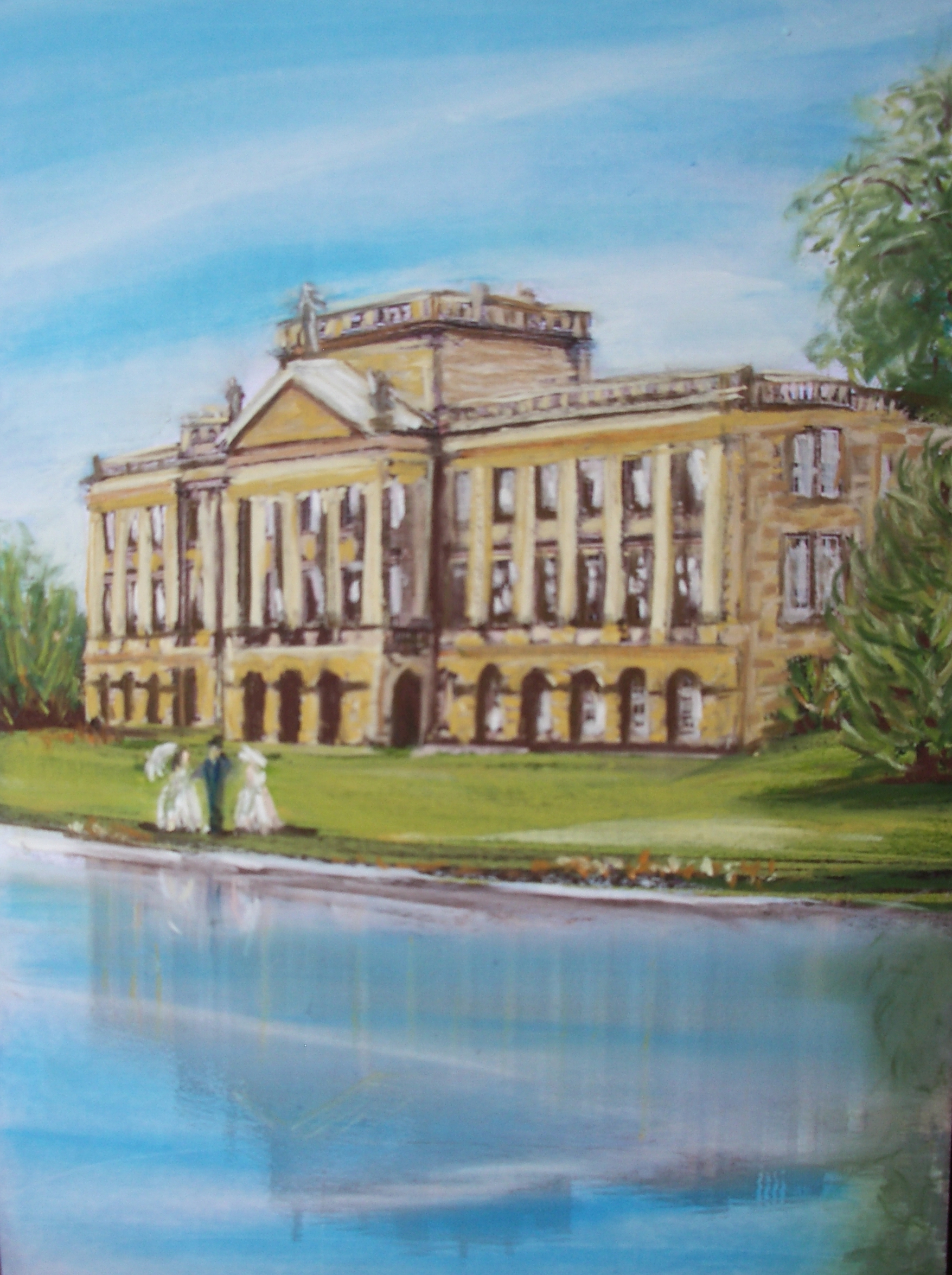
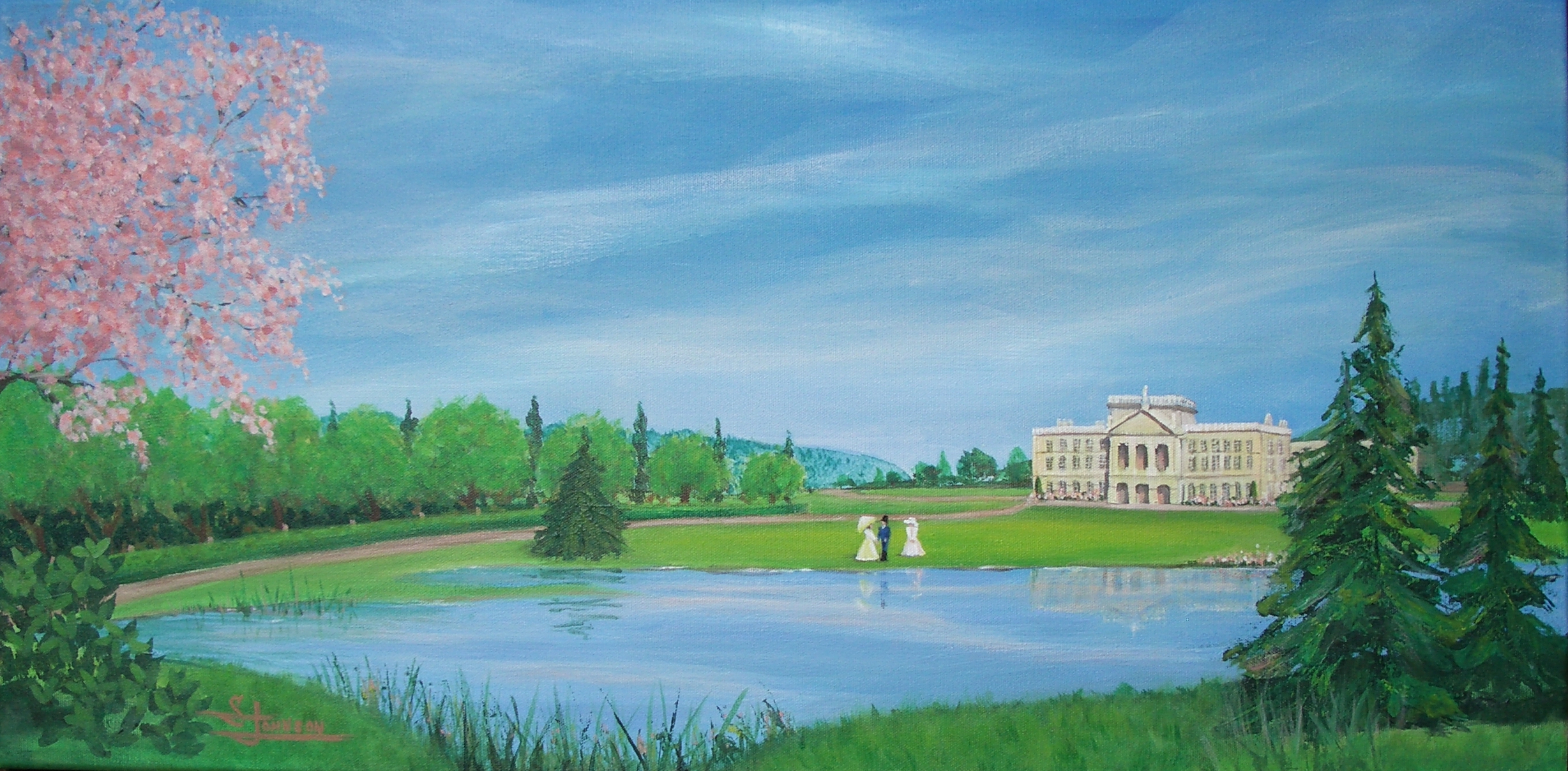
As I mentioned before, I’ve been working on producing a piece of artwork based on Lyme House (Pemberley in the ’95 film adaptation of Pride and Prejudice) to be used for the cover of The Darcys of Pemberley (to be released soon).  I did painting (A), a vertical pastel, but then I wasn’t sure I was totally satisfied with it.  So I decided to try another.  This time I did an acrylic on canvas (B), horizontal so that it can wrap around to form the back cover as well (see Blank Canvas).  Now I have two completed paintings – two options, two ways to go.  Choice is good, right?  The problem is that, just as with writing, it’s difficult to be objective about your own work.

“I have no right to give my opinion as to his being agreeable or otherwise. I am not qualified to form one. I have known him too long and too well to be a fair judge.  It is impossible for me to be impartial.”  (Pride and Prejudice, chapter 16)

Therefore, I’m throwing the question open for fresh opinions.  I hear you protesting, like Mr. Wickham above, “I am not qualified.”  Well, you may not have the credentials of an art critic, but every one of us has judged a book by its cover.  So help me out.  Which do you prefer and why?  Leave me a comment.

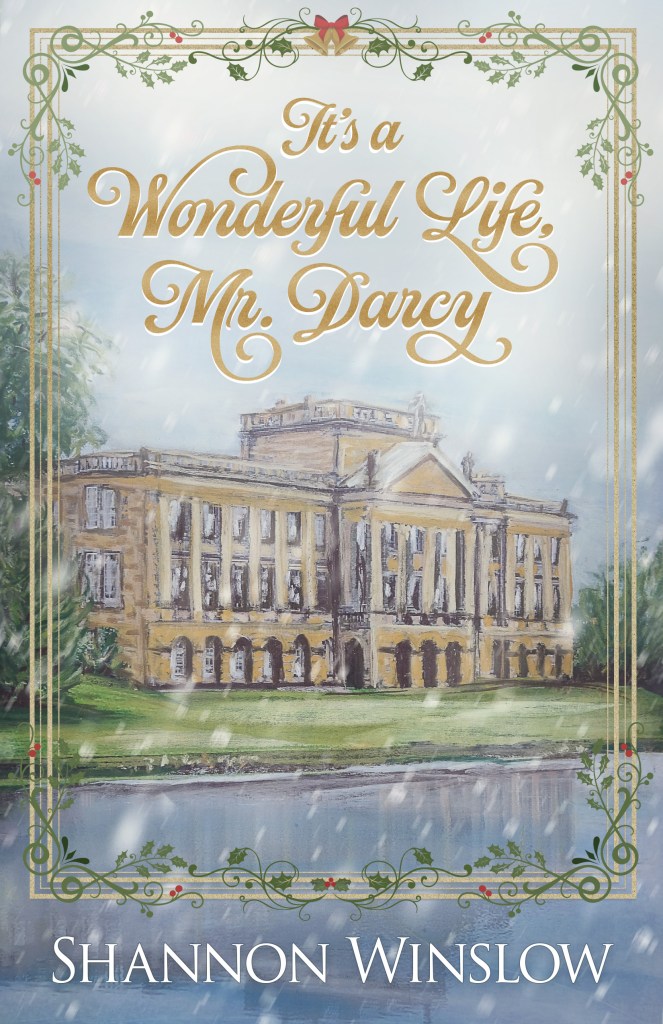
[PS – To see the finished wrap-around cover, click here.]

Posted in art, Jane Austen Quotes, Shannon Winslow's writing, writing | Tagged , , , , | 5 Comments

Perfect Refreshment

“I shall soon be rested,” said Fanny; “to sit in the shade on a fine day, and look upon verdure, is the most perfect refreshment.” (Mansfield Park, chapter 9)Finally!  Spring has arrived in the Pacific Northwest, and I’m reminded why I live here.  When the sun comes out, it’s glorious.  We have wonderful parks, waterways, and green spaces, so even city-dwellers can enjoy the outdoors.  Saying that reminds me of a passage in my third novel, Leap of Faith, which is set right here in the Seattle area:

She’d gotten a fresh look at Mt. Rainier from the plane, and then, as they’d made a wide turn for the approach to Sea-Tac airport, the woodsy islands crowding the south sound. Seattle was a big city.  Yet, whenever she wanted, a short drive or ferry ride would soon transport her far from the urban sprawl.  Even within town, parks, lakes, and pockets of tall fir and cedar trees provided a tangible thread of connection to the natural world.

I’m lucky in that I don’t even have to leave home to find that connection.  If it’s a fine day, I can sit and look upon verdure anytime I want.  You see, the photo above is the view from my back deck.  Ahhhh.  Perfect refreshment!

Posted in Jane Austen Quotes, Mt. Rainier, Shannon Winslow's writing | Tagged , , , , , , , , | 2 Comments

Backstory Hazard

When I did my final edit of The Darcys of Pemberley, I ran into a thorny issue all novelists have to address: how to handle backstory, the events that are supposed to have taken place before the action of the novel begins. The reader needs a certain amount for the story to make sense.  Determining when, how, and how much to supply is the tricky part.

How did Jane Austen deal with it?  She took a very straight-forward approach.  In five of her six novels, she served up a heaping helping of backstory narrative (at least a couple of pages of it) right at the beginning.  It makes sense; those events happened first chronologically and have a bearing on what follows.  In Mansfield Park, she starts her account a full three decades before the heroine, Fanny Price, arrives on the scene.

About thirty years ago, Miss Maria Ward of Huntingdon, with only seven thousand pounds, had the good luck to captivate Sir Thomas Bertram, of Mansfield Park, in the county of Northampton, and to be thereby raised to the rank of baronet’s lady, with all the comforts and consequences of an hansome house and large income.  All Huntingdon exclaimed on the greatness of the match, and her uncle, the lawyer, himself, allowed her to be at least three thousand pounds short of any equitable claim to it. (Mansfield Park, opening lines, chapter 1)

Austen goes on to tell us about the circumstances of Lady Bertram’s two sisters and how past events have brought things to the current state of affairs.  This is a simple, logical, and pragmatic way of dispensing backstory information.  Unfortunately for the modern writer, it’s no longer in vogue.  Pride and Prejudice is completely different, however, and a much better example of what is expected nowadays.  After the famous opening two lines, which set the theme and tone, we go straight into the action – a feisty conversation between Mr. and Mrs. Bennet.  So what happened to the backstory?  There’s less of it, and it’s doled out more gracefully, in small doses along the way as needed.

If the story absolutely requires a lot of set-up, the author had better make it entertaining, which reminds me of something I read in Save the Cat, Blake Snyder’s book on screenwriting.  He describes a useful device he calls “The Pope in the Pool,” a trick to make the delivery of necessary exposition more interesting.  The idea is that if you put the Pope in a swimming pool (or some other such unlikely scene) the audience will be so distracted by it that they won’t notice they are simultaneously being fed lots of necessary background information that would otherwise be boring.

So, how did I deal with the backstory issue for The Darcys of Pemberley?  I set out with the intention of making the novel stand on its own, to include enough background material so that people who weren’t familiar with Pride and Prejudice would still be able to follow and enjoy it.  That meant providing a LOT of backstory.  I put it in.  Then, with each rewrite, I took more and more of it out again until there’s barely a trace left, most of it in the brief prologue. 

Why did I ax it?  Well, I’d be cruising along through the story like I was rolling down a freshly paved highway in a big yellow convertible on a sunny day.  Then, suddenly, CLUNK.  I’d hit an unexpected chunk of backstory.  It brought the action to a screeching halt just as surely as a tire flattened by dangerous road debris.  It had to go.

So, be forewarned.  The Darcys of Pemberley is a direct and deliberate sequel; there’s no reason to pretend it’s anything else.  If you want to read it when it comes out in a month or two (and, naturally, I hope you will), start reading Pride and Prejudice now!  Additionally, or as a viable alternative, I recommend watching the ’95 BBC film adaptation starring Colin Firth.  That’s the most enjoyable way to collect all the backstory you’ll need.

Posted in Jane Austen, Jane Austen Quotes, Shannon Winslow's writing, writing | Tagged , , , , , , , , , | 2 Comments

Blank Canvas

I wish I had written down a great quote someone posted on Twitter the other day.  It went something like this: What a blank canvas is to the artist and empty paper is to the writer, silence is to the musician.  Since my creative interests carry me into the realms of art and music as well as writing, I’ve faced all three – most recently, the blank canvas.

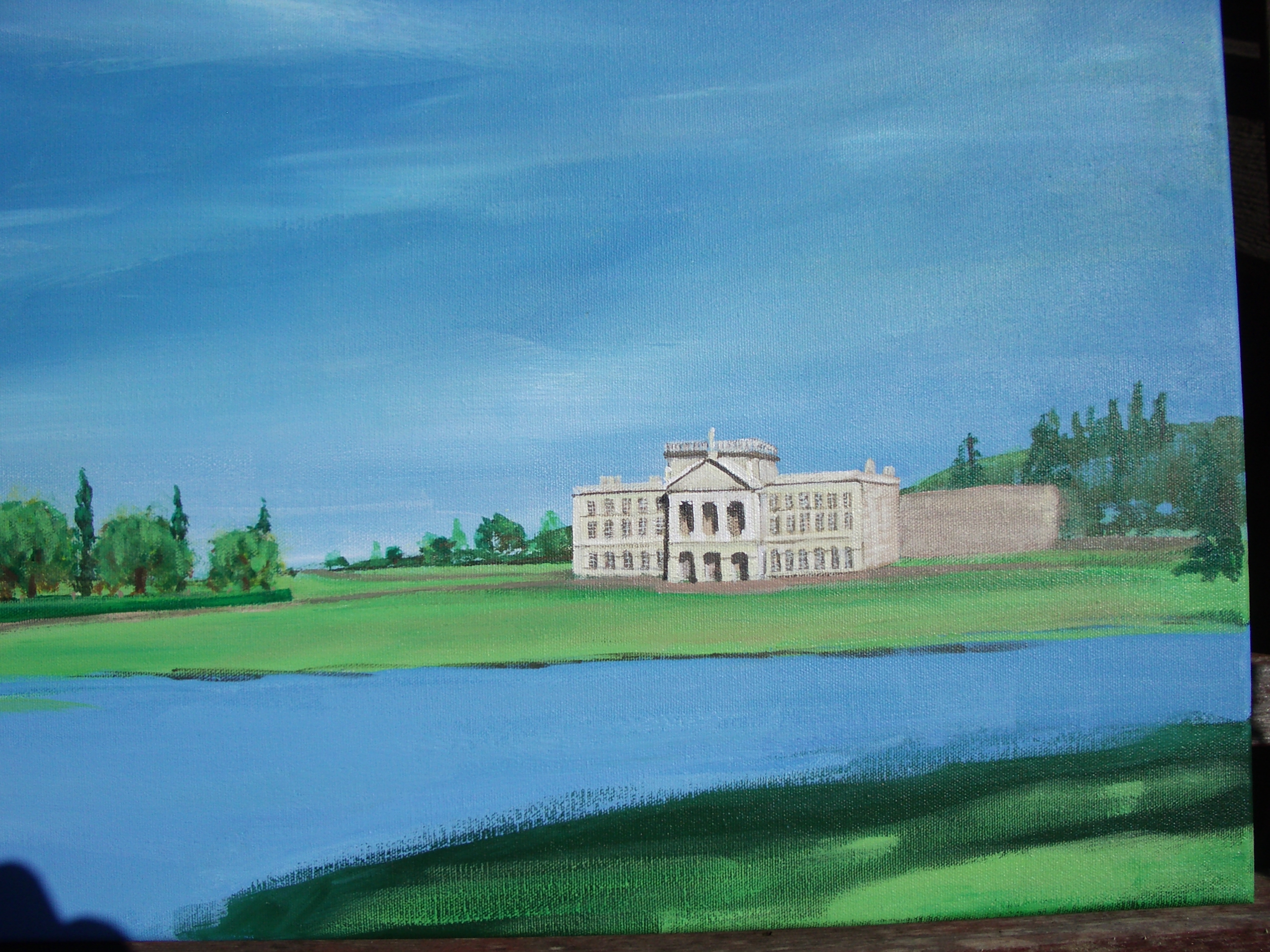
This morning I started the painting that I hope will turn into the cover art for The Darcys of Pemberley.  As I mentioned before (see Pemberley, the Picturesque), it will be loosely based on a view of Lyme House from the ’95 BBC production of Pride and Prejudice.  Here’s the work-in-progress.

It has a long way to go.  The house looks a little cold and lonely right now. I need to warm up the color, get the water looking like water, and do the entire foreground. But at least all that white canvas is gone.  So, I’ve made it over the first hurdle.

It’s the same for writing and singing; the hardest part is getting started. Staring at that ream of blank paper (or computer screen) is intimidating. Venturing out into an empty, expectant silence can be scary.  That sensible, timid voice in my head tells me, “It’s too risky. Safer not to try. Public humiliation awaits.”  Right now, for instance, I’m guessing you’re not all that impressed with my artistic abilities (and I’m not all that confident in them either, to tell you the truth). 

So, why do people keep painting, writing, and making music? Not for any tangible reward; most artists/writers/musicians will never see big fame or fortune. I think we’re simply compelled to fill the void. We can’t NOT do it.  Seen in proper perspective, those blank canvases, empty pages, and vacant silences are not foreboding.  Each one is an open invitation that’s too good to bypass, an irresistible opportunity to share a creative vision with others, the chance to make daily life a little richer.

I would rarely agree with Mrs. Elton, but she makes a good point here (which applies to all the arts, not only music):  “I honestly said that…the world was not necessary to me…Certainly I had been accustomed to every luxury at Maple Grove; but I did assure him that two carriages were not necessary to my happiness, nor were spacious apartments. ‘But,’ said I, ‘I do not think I can live without something of a musical society. I condition for nothing else; but without music, life would be a blank to me.'”   (Emma, chapter 32)

Blank: Not marked; lacking features or interest; uneventful or unproductive; emptiness of mind.  Now, we can’t have that, can we?

Posted in art, Jane Austen, Jane Austen Quotes, writing | Tagged , , , , , , | 4 Comments

Playing Mind Games

Maybe you’ve seen this circulating on Facebook:

AOCDRNDIGCG TO RSCHEEARCH AT CMABRIGDE UINERVTISY, IT DSENO’T MTAETR WAHT OERDR THE LTTERES IN A WROD ARE, THE OLNY IPROAMTNT TIHNG IS TAHT THE FRSIT AND LSAT LTEETR BE IN THE RGHIT PCLAE. TIHS IS BCUSEAE THE HUAMN MNID DEOS NOT RAED ERVEY LTETER BY ISTLEF, BUT THE WROD AS A WLOHE. IF YOU CAN RAED TIHS, PSOT IT TO YUOR WLAL.

I’ve seen this before, and I am totally fascinated by it.  So I decided to test the theory on my readers.  I’ve taken a paragraph from Jane Austen’s Pride and Prejudice (it’s chapter 61, but no fair peeking) and mixed up the letters for you according to the Cambridge criteria (although I think they only stirred whereas I thoroughly scrambled them).  See if you can read it as well as the paragraph above, and leave me a comment – preferably scrambled!  It’s hard for me to judge for myself if it’s working, since I already know what it says.

HPAPY FOR ALL HER MERNATAL FLINGEES WAS THE DAY ON WCIHH MRS BNENET GOT RID OF HER TWO MSOT DIVERSNEG DETRGAUHS.   WTIH WAHT DIGTELEHD PIDRE SHE ARTEWADRFS VETISID MRS BILGENY AND TEKALD OF MRS DRACY MAY BE GSUSEED.  I WSIH I CLOUD SAY, FOR THE SKAE OF HER FILMAY, TAHT THE ACMNEPSHLICOMT OF HER ENREAST DREISE IN THE EMBNESSTABLIHT  OF SO MNAY OF HER CLIDERHN, PRUCDOED SO HPAPY AN ECEFFT AS TO MKAE HER A SLEBINSE, ABLIMAE, WLEL-IMFOREND WAMON FOR THE RSET OF HER LFIE; THUGOH PAHPERS IT WAS LKUCY FOR HER HANBSUD, WHO MGIHT NOT HVAE RISHEELD DEIMOTSC FITCILEY IN SO USUNAUL A FROM, TAHT SHE SILTL WAS OCSNALOLAICY NOURVES AND IVABLAIRNY SLILY.

This whole idea kind of shoots down the importance of spelling correctly, doesn’t it?  PS -My laptop nearly had a melt down when I hit spell check for this post. 😉 Tee hee.

Conjectures as to the meaning of it, rapid and wild, hurried into her brain; but she was satisfied with none.  (Pride and Prejudice, chapter 51)

PS – For another example of this sort of thing, please see More Mind Games.

Posted in fun & games, Jane Austen, Jane Austen Quotes, Uncategorized | Tagged , , , , , | 12 Comments