Giving Some Account

“My Dear Cassandra:  Having half-an-hour before breakfast (very snug in my own room, lovely morning, excellent fire — fancy me!) I will give you some account of the last two days. And yet, what is there to be told? I shall get foolishly minute unless I cut the matter short.”  (from a letter, November 6, 1813)

Like Jane, I am very snug in my own room – my studio – but with no fire (in August, I’ll take a/c instead). It is a lovely morning, and my idea is to give you “some account” of what’s been happening the last couple weeks, as well as what’s coming up.

August 1st was a special day in that it represented the one-year anniversary of the successful release of The Darcys of Pemberley, something that has changed my life tremendously! In honor of the event, I’m doing a special give-away (see the post and enter to win here).

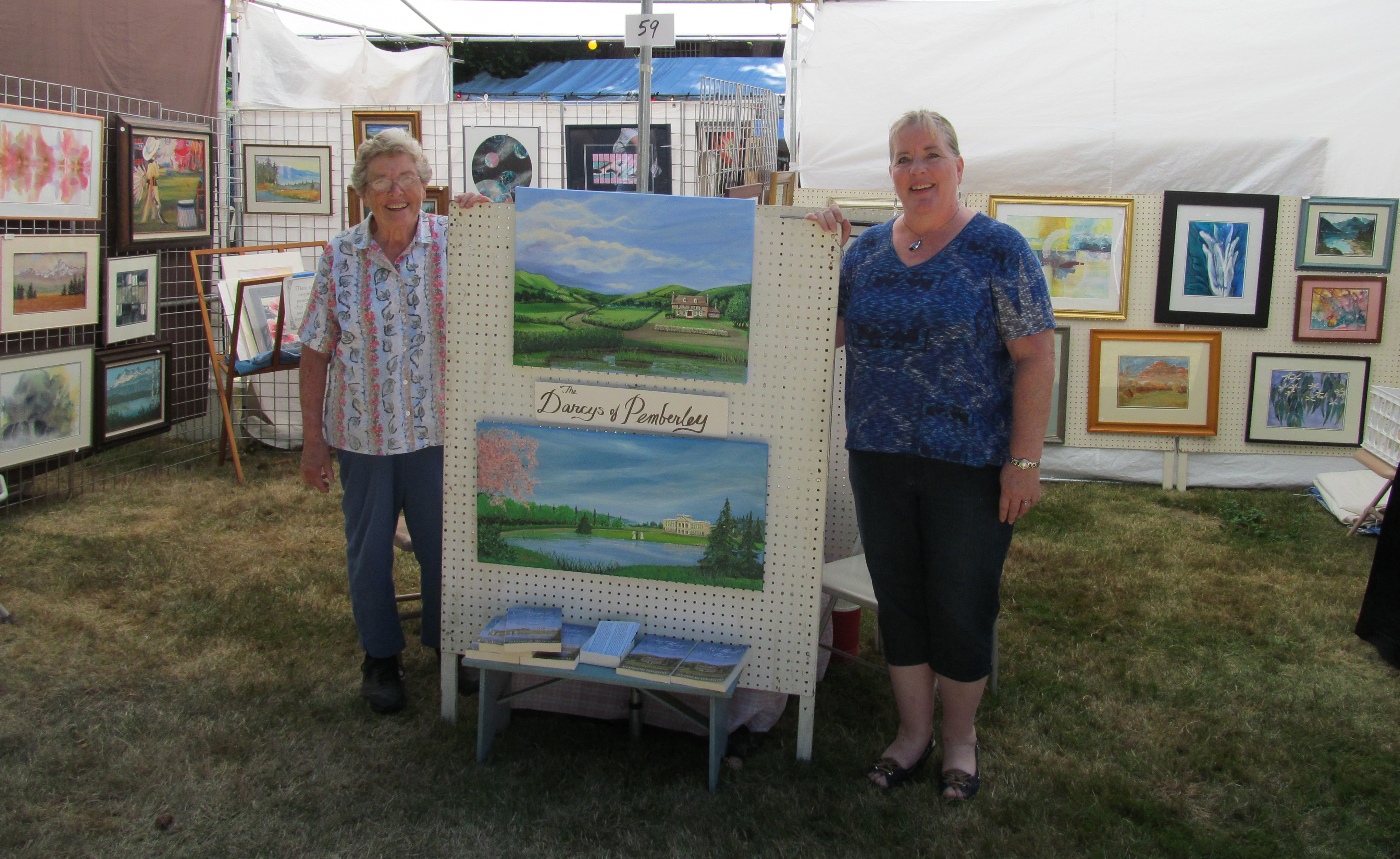
On the weekend of August 3-5, I participated in an outdoor art show in the nearby community of Eatonville, WA. After feeling smug and comfortable during the mild start to our Seattle summer, we finally caught up with the rest of the country that weekend, which meant I spent 3 days roasting out in the heat. Still, it was an opportunity to hang out with my mom (pictured) and to talk art and books with friends and visitors, something I will endure considerable inconvenience to do! (photo courtesy of John Pelkey)

Everything answered; it was all gaiety and good-humour, the heat only supplying inconvenience enough to be talked of with pleasure. (Mansfield Park, chapter 7)

Image 1

This past weekend (Aug 10-12) was even more eventful, starting off with a trip to the Queen Mary Tea Room in Seattle with fellow Austen author types Laurel Ann Nattress, Syrie James, Diana Birchall, and Susan Mason-Milks. We talked, ate, and drank tea for two hours and I daresay we could have gone on much longer – the talking at least. It was delightful to get to know these lovely ladies in person, most of our previous communication having taken place online. (photo courtesy of Susan Mason-Milk)

542468_505961876085113_197685995_n

The five of us, plus a few dozen other Janeites, reconvened two days later at the Seattle area JASNA meeting, where Syrie and Diana presented a highly amusing original playlet (titled You are Passionate, Jane) about a heavenly confrontation/conversation between Jane Austen and Charlotte Bronte. A special highlight for me was meeting one of my official fans afterward. Thanks, Julie, for making my day! (photo courtesy of Sallie Tierney)

Upcoming events: I’m participating remotely (my books, with pre-signed bookplates, will be there but I will not) at the Decatur Book Festival in Georgia over Labor Day weekend (look for the Jane Austen tent). I will be physically present at the Northwest Bookfest Sept. 22 & 23 (details here). 

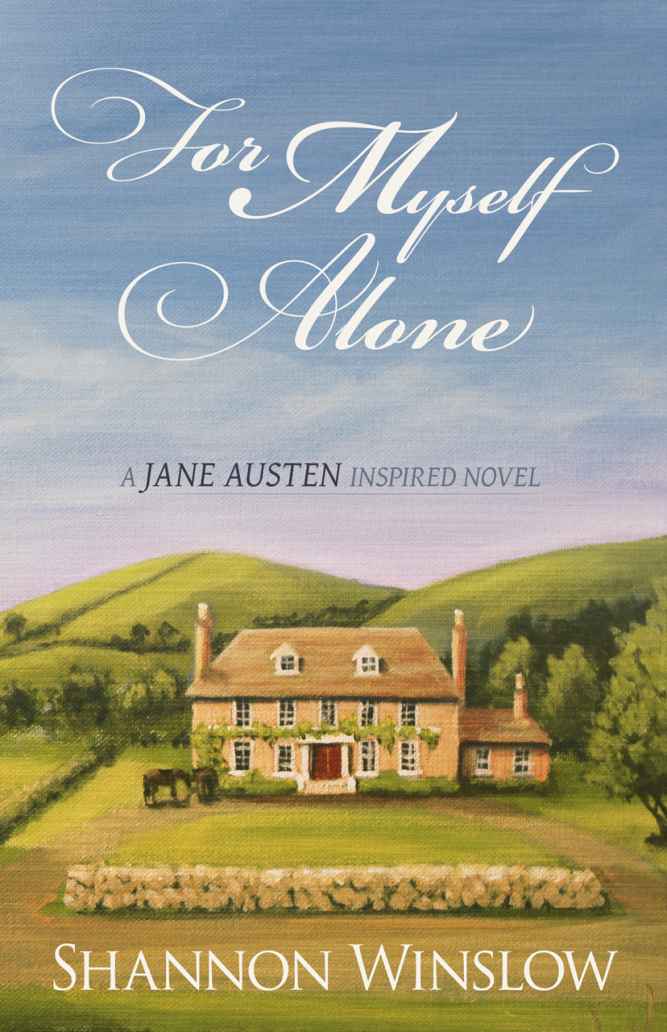
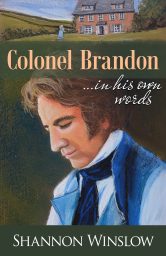
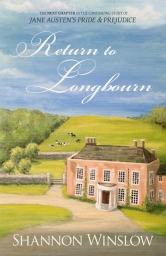
Book Updates: The Darcys of Pemberley continues to do very well in the American market and overseas (1/3 of all sales coming from the UK). I hope more of that book’s fans will soon discover my second release, For Myself Alone, is just as well worth reading. No, it doesn’t have Mr. Darcy in it, but there’s a couple other interesting leading men you should get to know. Return to Longbourn (the next installment of my P&P saga) is coming along nicely. I should have the first draft finished in a couple of weeks, and I hope (fingers crossed) to have the book out by the end of the year.

One more interesting development to mention. This past week, I was offered my old “day job” back. For a long time, that had been exactly what I had hoped for. So I thought about it. What do you think my answer was?

Posted in art, contests, Jane Austen, Jane Austen Quotes, my books, Shannon Winslow, Uncategorized | Tagged , , , , , , | 7 Comments

Midnight Express for Longbourn


Here’s another vignette I wrote for the Austen Authors P&P200 project, which follows the story of Pride and Prejudice in “real time” and supplementing it with different view points and “missing scenes.” The is one of the latter.

In the book, we (Jane Austen’s readers) are traveling merrily along with the Gardeners in Derbyshire, visiting Pemberley and watching the first hopeful hints of understanding blossom between Darcy and Elizabeth. We are not present at Longbourn when the fateful letter from Colonel Forster arrives, informing the Bennets of Lydia’s elopement. We only learn what has happened there belatedly and second hand (some through Jane’s letters and some through her further explanation once Lizzy returns). This is that “missing scene.” Read it here or at Austen Authors.


Midnight Express for Longbourn

The Bennet household had just settled down for the night after a day of industrious occupation. Mrs. Bennet had been to Meryton and argued not only with the butcher about her bill, but also with various ones of her neighbors who seemed to be circulating malicious rumors about that handsome officer she and her girls so much admired: Mr. Wickham. After exhausting herself in this manner, Mrs. Bennet had retired early, saying her head was very ill indeed.

Jane and Kitty had once again spent the entire day entertaining the lively Gardiner children whilst their parents were away to Derbyshire on holiday with Elizabeth Bennet in tow. 

Mr. Bennet alone had been able to preserve himself from excessive exertion, and had thus found he was quite able to stay up late, reading once again his favourite of Shakespeare’s plays (Much Ado About Nothing) and chuckling to himself at the silliness and absurdity he found there. Upon finishing, he thanked his lucky stars that his own household suffered no such dramas, and then he likewise retired to a gentle slumber.

Shortly after twelve, however, such a pounding came at the front door as would surely have awakened the dead. One by one, the Bennets tumbled out of their beds and down the stairs to see what the cause of all this unwelcome commotion was. It was an express, the contents of which turned out to be even more unwelcome.

Mr. Bennet, after paying the man and closing the door again, in silence read the letter, which was addressed to him:


My Dear Mr. Bennet,

It is with a heavy heart that I write to you with news that must bring you considerable distress. But I am afraid of alarming you. Be assured that your daughter is well, so far as it is within my power to judge. I am sorry to say that Miss Bennet last night removed herself from my house and from my protection. She has in fact eloped with one of my officers – Lieutenant George Wickham, whom you will remember.

From her own information – a brief letter left for my wife – we do at least know that she departed with him of her own accord and in very high spirits, stating that the couple’s intention was to make for Gretna Green and there to wed. I have no real reason for doubting this, only a general uneasiness over the gentleman’s character. He at first seemed to me to be as fine a young man as ever one could hope to meet with. On closer acquaintance, however, I have observed in him a worrying trend toward imprudence, this event being yet another evidence of it.

I feel myself in part responsible for what has occurred. You entrusted your daughter to my care, and I have failed to keep her safe from harm. I now pledge myself to do everything within my power to assist you in recovering her. I will closely question the men under my command, especially Wickham’s particular friends, to see what is to be learned here. Then I plan to come to you directly at Longbourn, to offer whatever service I may render you. Till then, please extend my humble apology and sincere respects to all your family.

 Yours, etc. Col. Forster


“Oh! What is it, Mr. Bennet?” cried his wife when he let his hand and the letter drop to his side. “Tell me at once. Have you no compassion for my nerves?” Thunderstruck and thoroughly incapable of speech, Mr. Bennet gave the letter to his wife, who in turn passed it on to her eldest daughter. “You read it to me, Jane. I am in too much of a tremble.”

But hearing the letter only increased Mrs. Bennet’s agitation. She was taken ill with hysterics immediately, and the whole house disintegrated into a state of utter confusion not soon to be recovered from. Moreover, there was nary a servant belonging to the business who did not know the whole of the story before the day was out. Within two more days the whole community knew of the Bennets’ troubles. Half their neighbors then had the goodness to pity them their great misfortune, and the other half were only too proud to say they had always predicted such an unfavorable outcome for the family.

Posted in Austen Authors, Jane Austen, Jane Austen Quotes, P&P200, Shannon Winslow | Tagged , , , , , , , | Leave a comment

Happy Birthday to “The Darcys of Pemberley”

It’s official! My first-born literary child just turned one! It’s been a full year since The Darcys of Pemberley began hitting bookshelves and e-readers around the world, and its success has far exceeded my expectations. So I feel like celebrating!

If you are a parent, you know what it’s like to send your child off on a new venture – be it kindergarten, college, an audition, or a job interview. You’re proud of your kid and you’re anxious that s/he should be well received by the world. It’s the same for an author. Your book is your “baby” and you want everybody to love it like you do.

Okay, so not quite everybody has read The Darcys of Pemberley (not yet, at least), but I’m so grateful for all those who have – especially for those who enjoyed it enough to recommend it to friends. I’m honored to think that something I wrote with much TLC may have been the topic of conversation over your girls-lunch-out, at book club, or at the gym.

To express my appreciation, I’m throwing a little party. I wish I could have you all over for birthday cake (chocolate, of course) and a spirited game of charades or whist, but my house is a little too small for that. So I’ll do what authors usually do and give away books to celebrate!

The main drawing is open to everybody, with five winners having their choice of prizes – any one of my books in your preferred format, or whatever other goodies I can come up with. Simply leave a lovely comment below and check back September 1st to see if you’ve won. Then I’ll contact you to find out your choice of prize.

But in addition, I want to do something kind of special for one true DOP fan. I’m offering a signed copy with hand-written annotations. Would you like to know the derivation of the names Sanditon and Heatheridge used in the book? Did you catch all the inside jokes? There’s actually a quote from The Godfather contained in the book. Did anybody notice that? Here’s your chance to find out all the inside scoop.

So, if you’ve already read The Darcys of Pemberley (or will have before the end of August), you can also enter to a win the specially annotated copy by sending me an e-mail (subject line: annotated DOP) at shannon(at)shannonwinslow(dot)com. In it, quote the opening sentence of chapter 32 to confirm you own the book.

I wish my budget could afford giving away and all-expenses-paid trip to Hawaii, but a virtual visit to Regency England through the pages of a book will have to do. Thanks again to everyone who has supported me through this past year. You really have helped to make my dream come true!

I wish you joy of your birthday twenty times over. I shall be able to send this to the post today, which exalts me to the utmost pinnacle of human felicity, and makes me bask in the sunshine of prosperity, or gives me any other sensation of pleasure in studied language which you may prefer. ( from a letter to her sister Cassandra, dated January 8, 1799)

Posted in contests, fun & games, Jane Austen, Jane Austen Quotes, Shannon Winslow, Shannon Winslow's writing, Uncategorized | Tagged , , , , | 39 Comments

Miss Dashwood Gets Down and Dirty

In Sense and Sensibility, Lucy Steele becomes the bane of Elinor Dashwood’s existence, the burr under her saddle, the mosquito whining in her ear. It is not simply that she has a prior claim to Edward Ferrars, which is bad enough, but the irritating way she rubs it in. Elinor endures it like a saint, of course, and we admire her for it. But sometimes I wish she hadn’t taken such a high road, that there had been another, more proactive, course of action open to her for dealing with her rival.

That’s the basis for this little tale I contributed to Bad Austen, a collection of short stories done in parody of Jane Austen’s writings (My other contribution, Woman of Wonder, is posted here). I thought you might enjoy it. We pick up the action at the point where Marianne has just learned that Edward has been secretly engaged to Lucy for years:


 Miss Dashwood Gets Down and Dirty

“How long has this engagement of Edward’s been known to you?” Marianne demanded.

“About four months,” Elinor rejoined.

“What!  And never a hint to your closest companions?”

“No doubt you would reproach me again for my reserve, and quarrel with me over my forbearance.  Would you question the existence of my heart as well because I choose to suffer my disappointment in private?”

“Indeed, I do not ask the location of your heart, for I vouchsafe that you have an organ of that description beating within your breast, and it may well be as susceptible to tender sentiments as any other person’s.  My question to you, Elinor, is this.  Where is your fighting spirit?  You have been grossly ill-used, and the time to take decisive action is come!”

“I admire your conviction, dearest, but what recourse is there within my reach?  The courts can give no satisfaction; no law has been broken.  What would you have me do?  Challenge Lucy Steele to a duel?”

“A tempting notion, is it not?”  Marianne sprang into a fencer’s stance and addressed a phantom rival with the cut and thrust of her imaginary saber.

“Marianne!  Have you completely taken leave of your senses?  Surely there can be no occasion for bloodshed.”

“Perhaps not, but I have heard of another equally satisfactory avenue for settling disputes.”  Marianne clasped her sister’s hand.  “Come, make haste!”

Her protestations notwithstanding, Elinor found herself unceremoniously dragged to her feet and from the room.  Marianne was unstoppable.  She collected their wraps and propelled them both out into the street, where they were fortunate to find a handsome cab standing at liberty.

“Where to, Miss?” the cabbie asked as the young ladies climbed in.

“Southwark.  To Vauxhall, and don’t spare the horses,” Marianne ordered.

They were off with the crack of the driver’s whip.

Elinor, who had been carried thus far by the sheer force of her sister’s will, at last spoke out.  “I must protest against this madness, Marianne.  You intend to take us across the river and into the Borough at this time of night?  And unescorted?  Only think what our mother would say to such a scheme!”

“Mama will never know.  Besides, it would be well worth any price for the chance to see you settle your score with Lucy.  It was, in fact, by overhearing her speak of the contest tonight that I learnt of it myself.  According to her information, this form of entertainment is quite the thing here in London now, so you need not be squeamish.”

Her scruples laid to rest by these reassuring words, Elinor’s mind eased from concern to mere curiosity.  As long as no breach of decorum was involved, a new diversion would be welcome.  One could not go to the opera every night of the week, after all.  But how a Vauxhall amusement could render any amendment to a broken heart, Elinor could not begin to fathom.

“Be patient,” Marianne answered when asked.  “You will see soon enough.”

Elinor’s bewilderment only increased upon their arrival, however, for she heard sounds of a great tumult emanating from the vast tent to which her sister steered her.  “This cannot be entirely proper,” she said.  “Ladies and gentleman never raise their voices in such a manner at the theatre or at a ball.”

Marianne pressed ahead, taking no notice.  Another moment and they were both inside the canvas enclosure, hemmed about on all sides by crowds of unruly persons, many of whom were of dubious lineage.

Elinor stood transfixed for a long moment, not believing her eyes.  “B-but Marianne, those t-two young ladies …”  Elinor pushed forward for a better view.  “They seem to be …”

“Yes, they are indeed!” Marianne confirmed.  “Glorious, is it not?”

“I hardly know.  I would not have imagined such a thing possible … or prudent,” Elinor murmured, tilting her head this way and that as she followed the movements of the female contenders.  An inner voice whispered that she should be repulsed, that she ought to turn on her heel and flee the den of iniquity at once.  Yet she found that she could not; she was irresistibly drawn to the spectacle before her.

The singular visage of Lucy Steele suddenly appeared amongst the onlookers across the way, and, when their eyes met, Elinor shot her a pointed look through the steamy atmosphere betwixt them.  Lucy nodded, accepting the silent challenge.  As if by some audible signal, they started towards each other at the very same moment.  The crowd cheered, apprehending that some considerable augmentation to the evening’s entertainment was forthcoming.

With an expression of exhilaration overspreading her countenance, Elinor cast caution to the wind, hoisted up her skirts, and waded into the mud-filled arena to meet her adversary.


“For four months, Marianne, I have had all this hanging on my mind, without being at liberty to speak of it to a single creature… It was told me, it was in a manner forced on me by the very person herself, whose prior engagement ruined all my prospects…” (Sense and Sensibility, chapter 37)

Posted in Austen Authors, Jane Austen, Jane Austen Quotes, Shannon Winslow's writing | Tagged , , , , , , , , | 6 Comments

A Sister’s Love and Loss


Today is the 195th anniversary of Jane Austen’s death. Not an occasion to celebrate, but to take respectful note of. She died at age 41 of what may (or may not) have been Addison’s disease, according to one current theory based on her known symptoms – treatable now, but not in 1817. 

So instead of quoting Jane herself this time, I will quote someone in a better position to comment on the sad event: her beloved sister Cassandra. As you will see from the short excerpt below (taken from a letter Cassandra wrote to her niece shortly thereafter), the two were exceptionally close. 

“I have lost a treasure, such a sister, such a friend as never can have been surpassed. She was the sun of my life, the gilder of every pleasure, the soother of every sorrow; I had not a thought concealed from her, and it is as if I had lost a part of myself. I loved her only too well — not better than she deserved, but I am conscious that my affection for her made me sometimes unjust to and negligent of others; and I can acknowledge, more than as a general principle, the justice of the Hand which has struck this blow… I thank God that I was enabled to attend her to the last, and amongst my many causes of self-reproach I have not to add any wilful neglect of her comfort.”

(If you would like to read the rest of this letter, visit Jane Austen’s World here.)

I’ve always believed that Austen’s portrayal of the relationship between Jane and Elizabeth Bennet in Pride and Prejudice most closely reflects her own relationship with her sister Cassandra. They confide in each other, share each other’s hopes and dreams, and feel each other’s pain. You get the impression that either one of them would have, without a second thought, sacrificed her own happiness to secure her sister’s.

Just as Elizabeth Bennet left the comfort of home to nurse Jane when she was ill at Netherfield, so Cassandra Austen did for her sister. She traveled with Jane to Winchester to seek medical treatment for her, and stayed with her to the end.

Do you have a sister that you feel especially close to? Which pair of sisters in a Jane Austen novel reminds you most of your relationship with your sister?

Posted in Jane Austen, Shannon Winslow | Tagged , , , , , , | 8 Comments

Meet Me at the Library

Tomorrow (7/11/12), I’m giving a program at my local library. It’s on Jane Austen and her legacy, especially how it sparked my own career as an author, with a reading and signing included. It’s going to be informal, interactive, and fun. If you’re in the Seattle/Tacoma area, I’d love for you to stop by! (find more details here)

 
With the brick-and-mortar bookstores sadly disappearing, libraries are becoming increasingly the sole center of the book world for a lot of communities, even hosting author events like the one I’m doing. They have had to change with the times and technology, but, for now at least, library shelves are still filled with old-fashioned, physical books that have passed from hand to hand and given up their treasures to one reader after another. For the true bookworm, the lure is irresistible.
 
In Jane Austen’s day, libraries were more a private affair, and collecting books primarily the purview of the upper classes. Every great house had a library. In Pride and Prejudice, for instance, Mr. Bennet is always retreating to the safe haven of the library at Longbourn; Mr. Bingley apologizes that he doesn’t have a larger collection of books in his at Netherfield; and Miss Bingley praises Mr. Darcy’s delightful library at Pemberley. “It ought to be good,” he replied, “it has been the work of many generations.”
 
If you were not wealthy enough to have a vast collection of your own books, you could purchase a subscription to the circulating library in the nearest good-sized town. That’s what poor Fanny Price has to resort to when she is temporarily sent away from Mansfield Park to her birth family’s home in Portsmouth. She cannot replace all she’s lost, but books are a comfort still within her reach.
 
She often heaved a sigh at the remembrance of all her books and boxes, and various comforts there… The remembrance of the said books grew so potent and stimulative that Fanny found it impossible not to try  for books again. There were none in her father’s house; but wealth is luxurious and daring, and some of hers found its way to a circulating library. She became a subscriber; amazed at being anything in propria persona, amazed at her own doings in every way, to be a renter, a chuser of books! And to be having any one’s improvement in view in her choice! But so it was. Susan had read nothing, and Fanny longed to give her a share in her own first pleasures, and inspire a taste for the biography and poetry which she delighted in herself. (Mansfield Park, chapter 40)
 
Notice that part of the enjoyment Fanny anticipates is sharing the delight of reading with someone else (in this case her younger sister, Susan). Isn’t that true of all of us? Books are a pleasure we long to share. Which brings me back to Wednesday’s event at my local library. Like Fanny, a large part of the enjoyment I anticipate from that evening is in sharing my love of books and reading with others.
 
Who have you shared  your love of books with? Who first taught you to love reading?
Posted in Jane Austen, Jane Austen Quotes, learning, my books, Shannon Winslow's writing | Tagged , , , , , , , | 12 Comments

How to Tour of Bath, England, in 90 Minutes or Less

Here’s my latest post on Austen Authors:

My husband works for Boeing and he occasionally travels with his job, jetting off to exotic vacation destinations like Glasgow Montana, Roswell New Mexico, and Fairbanks Alaska in the dead of winter. Needless to say, I’ve never felt the desire to accompany him on these business trips. But a few years ago, he casually dropped the news that he was being sent to Venice, Italy, for a couple of weeks, and asked if I wanted to go.

When I finally finished squealing with delight and jumping up and down, I ran to find my passport, arranged for a sub at work, and began making reservations. Boeing had taken care of my husband’s travel arrangements, but I was on my own. The first thing I discovered was that there are no direct flights from Seattle to Venice. I would have to stop over, or at least change planes somewhere – Rome, Amsterdam, Berlin, or London.

London? Hmm. That’s when the wheels started turning.

I was at the time working on my second Jane-Austen-inspired novel, For Myself Alone, which is set partially in Bath. I’d gleaned what I could about the town from Austen’s writings and other sources, but I couldn’t help thinking how fantastic it would be to visit the place in person. If I had to pass through London anyway, why not stay a day or two and hop on an excursion to Bath? An inspired idea! So, I booked two nights at a London hotel and started hunting for a tour to Bath.

In hindsight, it probably would have been smarter to consult a train schedule. But, since I’m not a seasoned international traveler, I was still hoping to avoid the scary prospect of navigating public transportation on my own in a foreign country. So I signed on to the only bus tour I could find going to Bath, with the bonus that it made stops at Hampton Court Palace and Stonehenge on the way. The big plus was that it was supposed to pick me up at my hotel. Nothing could be simpler or more convenient. Right?

They arrived at Bath. Catherine was all eager delight – her eyes were here, there, everywhere as they approached its fine and striking environs, and afterwards drove through those streets which conducted them to the hotel. She was come to be happy, and she felt happy already. (Northanger Abbey, chapter 2)

As you may have already guessed, my carefully laid plans didn’t work out exactly as I had envisioned. Turns out that when the tour company advertised “hotel pick up service,” they didn’t mean my hotel. But, a city bus and subway ride later, I caught my tour and I was on my way. Hampton Court was very interesting and Stonehenge captured my imagination more than I had expected, yet I was chomping at the bit to move on to Bath. I longed to see for myself the places Jane Austen mentioned in her books, and to spend the entire afternoon strolling the cobbled streets she knew so well.

When we at last rolled down from the hills into town, I craned my neck and was delighted to catch sight of the Pultney Street Bridge over the Avon. That was the first “check” on my list of must-sees. Yay! The bus parked behind the Abbey and, before turning us loose, our guide matter-of-factly informed us what time we needed to be back aboard. I gasped. I want to scream in protest. An hour and a half?!? That was nowhere near enough time!

Nothing I could say or do would change the schedule, however. It was be back at the appointed time or get left behind. So, with the stopwatch already running, I raced off.

I hurried through the Roman Baths, learning from an on-site guide how the place would have looked entirely different in 1800 (check). Next, the Pump-room (check), where I sampled the healing mineral water from The King’s Fountain (check) – warm but not nearly as redolent of sulfur as I expected. Then I crossed the churchyard for a quick tour of the Abbey (check), with its soaring ceiling and magnificent stained glass windows on all sides. I paused in a pew for a couple precious minutes, to take it all in before reluctantly moving on.

With a glance at my watch, I decided to head for the Royal Crescent. Here’s where Bath’s terrain comes into play. The oldest part of the town was established on a fairly level area beside the river. But it later spread out from there, up the slopes of the surrounding hills. So when you read in Northanger Abbey that Catherine Morland is attending a ball at the “Upper Rooms,” it’s called that because these newer assembly rooms are literally at a higher elevation than the old ones. What it meant for me, however, was that the hike to my destination would be all uphill.

Along the way, I had the presence of mind to turn and look for Beechan Cliff (check), which I could see peeking out over the tops of the Georgian-style buildings. Then I luckily stumbled across the Jane Austen Center (check) on my way up Gay Street. Wishing I had an hour to spend, I popped in just long enough to purchase a couple of informative books from a helpful clerk.

A little further up the street, I entered The Circus (check), a circle of connected town houses in three segments, with a green at the center. I wondered if the same old trees stood there in Jane Austen’s day (No, according to my research later).

Exiting the Circus to the left, I finally reached the Royal Crescent (check), with its expansive front lawn and famed gravel walk (check, check). I admired the view, took a few pictures, and then turned to run for the bus.

I’m sure I looked like a mad woman, flying down the gravel walk and cobbled streets as if pursued by an 18-century apparition. I was in a panic; I had already used up every one of my ninety minutes and now pictured the bus pulling away without me. It didn’t, but I got a reprimanding glare from the guide when I climbed back aboard, excessively out of breath and precisely seven minutes late.

Lucky thing they waited for me, or was it? Thinking back, I feel fortunate that I got the chance to see Bath, and I’m amazed how much I was able to accomplish in so short a time. But, oh, how I wish I could have stayed longer! If I’d missed my bus, I would have had my wish… and another story to tell.

Posted in Austen Authors, Bath, England, Jane Austen, Jane Austen Quotes, my books, Shannon Winslow's writing, travel, Venice | Tagged , , , , , , | 2 Comments

Elizabeth Remembers…

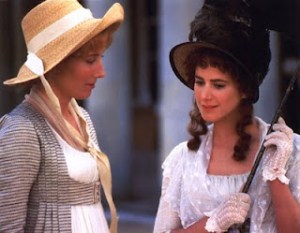
Jane Austen, Abigail ReynoldsA few weeks ago, I shared a post I wrote for the Austen Authors P&P200 project – a “real-time” review of Pride and Prejudice leading up to the book’s 200th anniversary of publication. The idea is to augment the book with scenes that are implied but not written in the original novel, or to retell existing scenes from a different point of view.

Here’s my next assignment: Elizabeth thinks about Darcy and reviews his letter again. This is supposed to take place shortly before she goes to Derbyshire with her aunt and uncle Gardiner. I based what I wrote on this short excerpt. The rest is my imagination. Read it here in its entirety, or at Austen Authors. Hope you enjoy it!

With the mention of Derbyshire, there were many ideas connected. It was impossible for her to see the word without thinking of Pemberley and its owner. “But surely,” said she, “I may enter his county with impunity, and rob it of a few petrified spars without his perceiving me.”  (Pride and Prejudice, chapter 42)


Elizabeth Bennet:

Derbyshire. That one word brought it all flooding back to my mind, all that I had so studiously endeavored to put from it. My heart had been set on seeing The Lakes, but my aunt’s letter two weeks ago not only put an end to that thrilling expectation, but replaced it with something like apprehension at the thought of diverting to Derbyshire instead. Even now, I am tormented by the idea.

 I cannot think of Derbyshire without unhappy associations rising up in my mind. No doubt it is grand country, full of beauties that are not to be missed. But to me it can only ever mean one thing; I will be entering the county wherein resides the owner of Pemberley, a man I had fervently hoped never to meet with again in the whole course of my life. And I know he must feel the same. For proof of it, I have only to refer again to his letter.

Why I have kept it, I cannot rightly say. It is not normally in my nature to dwell on unpleasantness. But in this case, I make an exception. My culpability in the debacle with Mr. Darcy is something I dare not forget entirely, lest I should ever behave so badly again. How despicably I acted! How dreadfully I misjudged him! His written words at last taught me to properly know myself, and I have resolved to revisit them occasionally as a sort of penance.

 Pulling the letter from its hiding place, I peruse its pages once more. The truth of his explanations concerning the two charges I so vehemently laid at his door, I have long since ceased to question. I need not read those sections again; I know them by heart.

 Mr. Darcy’s interference with Jane and Mr. Bingley is something I continue to lament most grievously for my sister’s sake, although I can no longer bring myself to hate him for it. There was no malice in the case, only an error in judgment – a failing to which I proved similarly susceptible in the other matter. When I think what he and his sister suffered at the hands of Mr. Wickham, I believe I better understand some portion of his actions in Hertfordshire, some grounds for his distrustful reserve.   

 Although his careful explanations are most material in exonerating his character, it is always the beginning and the end of Mr. Darcy’s letter that cut me to the quick. That is where my conscience seeks to punish me, for that is where the man himself and how I have injured him are most clearly revealed.

 Be not alarmed, Madam, on receiving this letter, by the apprehension of its containing any repetition of those sentiments, or renewal of those offers, which were last night so disgusting to you. I write without any intention of paining you, or humbling myself, by dwelling on wishes, which, for the happiness of both, cannot be too soon forgotten…

 And then at the end…


 …If your abhorrence of me should make my assertions valueless, you cannot be prevented by the same cause from confiding in my cousin; and that there may be the possibility of consulting him, I shall endeavour to find some opportunity of putting this letter in your hands in the course of the morning. I will only add, God bless you.

 Fitzwilliam Darcy

Oh, how these words have tortured me! If I still believed him to be a man without feeling, I could laugh at my own blindness well enough. Yet here is evidence that he has a heart after all, one capable of caring deeply… and being just as deeply wounded. Even should he one day find the charity to forgive how I have insulted him, I shall never forgive myself. But neither can I be content to wallow forever in self recriminations. I was not formed for unhappiness.

No, the only safe solution is that I never see Mr. Darcy again. He may get on with his life, well rid of me, and I will get on with mine, a little better for having known him. So there’s an end to it. Now, if only I can tour Derbyshire without him crossing my path…

(letter excerpts from Pride and Prejudice, chapter 35)

Posted in Austen Authors, Jane Austen, Jane Austen Quotes, P&P200, Shannon Winslow's writing, Uncategorized | Tagged , , , , , , , | Leave a comment

A Three-Hour Tour

With my lighter summer schedule, I’ve finally made some significant headway on my current work-in-progress. Return to Longbourn is the sequel to the sequel to Pride and Prejudice. In other words, it follows The Darcys of Pemberley

One of the scenes I wrote yesterday has Mary Bennet stuck for 3 hours alone in a carriage with Mr. Darcy. A dream come true? Not for Mary. Darcy’s married to her sister, remember. Plus he’s not the easiest person to talk to, especially for someone as socially awkward as Mary. She draws upon her recent experience with a similar guy – Mr. Farnsworth, the current master of Netherfield Hall, where she is governess. Here’s an excerpt: 

Her longstanding acquaintance with Mr. Farnsworth should have somewhat prepared her for confinement with Mr. Darcy. The two men were not unlike in some ways – the same powerful presence, the brooding and taciturn tendencies. Yet with Mr. Farnsworth, Mary had the children in common. They were the starting point for nearly all their conversations. What did she have in common with Mr. Darcy? Only Elizabeth and an appreciation for books and music. She supposed those topics would have to serve.

As Mary puzzled over how to begin, Mr. Darcy opened the conversation himself. Five minutes down the road, he said, “This seems a very fine carriage. Your employer must be a gentleman of considerable means. Do you find him a just and principled man as well?”

Mary was taken aback by this inquiry and nearly as surprised by her own response. “I… I’m not sure I have ever seriously considered the question. But I believe he is. He may rant like a despot, and we sometimes argue over what is best for the children, yet Mr. Farnsworth has never been anything other than honorable and scrupulously fair to me personally. Beyond that, I cannot say.”

“That speaks well of him. The true measure of a man is not taken by how he treats his peers and betters, but in how he deals with those over whom he holds unconditional power – his wife, his children, his tenants, those in his service and employ. If he treats them fairly when he has no one but his own conscience to answer to, then he is honorable indeed. Outsiders do not know what goes on in another man’s house, but his servants do. Therefore, it is their approbation that is most worth the earning. What praise is more valuable than the praise of an intelligent servant? I should much prefer it to the commendation of a lord.”

“Truly? That is very well said, sir.”

Mary was struck not only by the admirable nature of his sentiment but by its length. She could not recall ever hearing her brother-in-law speak so many words together before. He seemed to have exhausted his full supply at this, however, for not another did Mr. Darcy utter for a good half hour.


Only two and a half hours to go. What will they talk about the rest of the way? I’ll admit, Mary and I are stumped. Any ideas?

“He is the best landlord, and the best master that ever lived. Not like the wild young men now-a-days, who think of nothing but themselves. There is not one of his tenants or servants but what will give him a good name.”  (Mrs. Reynolds about Mr. Darcy, Pride and Prejudice, chapter 43)

Posted in Jane Austen, Jane Austen Quotes, my books, Shannon Winslow's writing, Uncategorized | Tagged , , , , , | Leave a comment

Mr. Collins Lives

As most of you know, I did my best to rid the world of the specter of Mr. Collins long ago. I documented his death in The Darcys of Pemberley and expanded on the story in Mr. Collins’s Last Supper. But guess what? He’s back – alive and well and carving out a good living for himself as a TV talk show host. I recently had the surreal experience of being interviewed by him for his show Meet the Author. He’s the one who’s in for a shock, though.

The interview was originally published on Barbara Tiller Cole’s blog Darcyholic Diversions. But it’s now reproduced in full below. Read it either place.

~~~~~~~~~~~~~~~~~~~~~~~~~~~~~~~~~~~~~~~~~~~~

William Collins, celebrated TV talk show host, speaks with today’s guest: author Shannon Winslow

Stage Director: And we’re live in five, four, three…..

(The applause sign lights, and Mr. Collins, sitting opposite his guest in a matching swivel arm chair, smiles benevolently as he waits for the ovation of the studio audience to die down)

Collins: Good morning, Ms. Winslow, and thank you for joining me here on Meet the Author.

Winslow: My pleasure, Mr. Collins. But I suppose I should call you Sir William and congratulate you on your recent elevation to the knighthood.

(Another smattering of applause)

Collins: I thank you, madam, but there is no need to stand on ceremony here. Although I have been so fortunate as to attain a measure of greatness – not without the assistance of a series of noble patrons, I might add – I do not forget my humble origins as a country parson.

Winslow: Nevertheless, I’m sure this latest honor is well deserved.

Collins:  I flatter myself that it is, for my ‘unique contribution to the literary world and decades of faithful service to the crown.’ I believe that was the exact wording. You may read the entire transcript at your leisure, Ms. Winslow. My assistant will supply you a copy.

Winslow: That’s very kind, but no one needs to remind me of your contribution to the literary world. Your character is legendary and has proven extremely valuable to my own modest literary efforts.

Collins: Then I am gratified, as indeed I always am, to have been of some small service. Now, I regret to confess, Ms. Winslow, that with all the demands on my time, I have not as yet read any of your work. However, I am told that you have a new book out. Have I been rightly informed?

Winslow: You have indeed! My second novel, For Myself Alone, was recently released, and I’m excited about the excellent reviews it’s received.

Collins: That is all very well, but what I wish to know is this. Am I in the book?

Winslow: Not exactly. You see, although For Myself Alone is ‘Jane Austen inspired,’ it’s an independent story with all new characters. I imagined what her next book might have been, and that’s what I wrote. Then I slipped in lines from her novels here and there just for fun. But you’ll be glad to know that one of those quotations is yours, Mr. Collins.

Collins: Excellent!

Winslow: “You can hardly doubt the purport of my discourse. My attentions have been too marked to be mistaken.” From the proposal scene, remember?

Collins: How could I forget? More immortal words have rarely been spoken, and they should rightly have carried the day. But I digress. Tell me about your first novel. What is it called again? I’m told it is quite successful, but the name escapes me. There is, after all, so much quality literature available at present that although I spend hours a day studying in my book room, which fronts the road by the way, I cannot possibly keep up.

Winslow: Perfectly understandable. My first book is The Darcys of Pemberley, a sequel to Pride and Prejudice. It came out last August and is doing very well, both in England and America, I’m happy to say. Of course, all of us would have loved the original author to write the continuing story. But, as she was unavailable, I did my best to stand in her place, to be true to her characters and style. I only hope I have done her justice.

Collins: Doubtless Miss Austen would be flattered that you hold her in such high regard. Now, back to me. I believe you said before the show that I play an important role in this novel.

Winslow: Oh, yes! A crucial role. I can’t imagine how I would have managed without you, Mr. Collins. In fact, you were the first person I thought of when I sat down to write. It came to me out of the blue that the story simply must begin with you. And then I later expanded the scene into a successful short story.

Collins: Well, I must say I am impressed with your obvious taste and flawless literary instincts, Ms. Winslow, for knowing at once where – and with whom – to start. And I trust my character features prominently right through the book to the last scene. In which case it occurs to me that you might have chosen the title with more circumspection – The Clergyman of Hunsford, perhaps – for The Darcys of Pemberley implies that the center of attention will be Mr. Darcy, my cousin Elizabeth, and their local society. You would not wish to lead your readers astray, would you?

Winslow: Oh, dear! Didn’t anyone tell you?

Collins: Tell me what, pray?

Winslow: That the novel is mostly about Darcy, Elizabeth, and their closest friends. I’m sorry to disappoint you, Mr. Collins, but your character’s moment in the sun, while glorious, is unfortunately rather brief. In fact, he has the great misfortune to die at the very outset of the story.

(The audience gasps and Mr. Collins blanches alarmingly, his mouth gaping open in silent horror)

Stage Director: Cut! Go to commercial!

“You can hardly doubt the purport of my discourse, however your natural delicacy may lead you to dissemble; my attentions have been to marked to be mistaken.”  (Mr. Collins to Elizabeth Bennet, Pride and Prejudice, chapter 19)
Posted in Jane Austen, Jane Austen Quotes, my books, Shannon Winslow's writing | Tagged , , , , , , | Leave a comment