Don’t you love the title? Once it came to me, I had to go with it.
However little Mr. Darcy might have liked such an address, he contented himself with coolly replying that he perceived no other alteration than [Elizabeth] being rather tanned, no miraculous consequence of travelling in the summer. (Pride and Prejudice, chapter 45)
With a lead in like that, I should either show you my gorgeous summer tan or maybe my sagging middle. But my tan is not that impressive and my sagging middle is… Well, we’ll get to that later. Let’s focus on Jane Austen first, specifically her travels – summer or otherwise.
Jane Austen actually got around a little more than you might think. She lived in Steventon, Hampshire, in Bath, in Southhampton, and finally at Chawton. She went to boarding school in Oxford and Southhampton as a child. She visited friends and family in places like Kent, Ibthorpe, Bath, Winchester, Clifton, and Adlestrop. She made it to London several times for business and pleasure. And she vacationed with her family in seaside resort towns such as Sidmouth, Colyton, and Lyme Regis.
Not bad, and a bonus for us is that she wrote a lot of letters when she was away (or when her sister was), and many of those letters survived and are available for us to read! But my guess is she would have liked to travel more if she’d had the means.
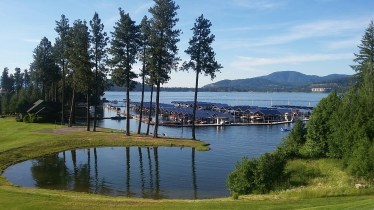
Lake Coeur d’Alene, Idaho
The same is true for my husband and me, although the limiting factor for us has been time as much as money. Like everybody else, we were busy with careers, kids, and keeping up at home. Even after our sons were grown and I quit my “day job,” my husband was still working, time and overtime, for a few more years. Now, that’s changed. This was the first summer we were more free to go and do. So, go we did!
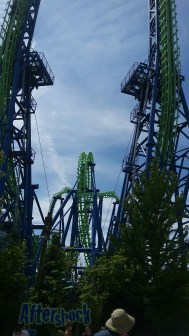
The scariest ride at Silverwood
Nothing grand this year. Like Jane Austen, no world tours (although technically we did go “abroad” – to Canada). Just stuff in neighboring states and across the border to British Columbia. When our son asked us to go with his family to Silverwood (an amusement park in Idaho), we said “Sure!” When I was invited to a Jane Austen festival at Port Alberni on Vancouver Island, I said “Count me in!” When my husband told me he wanted to visit relatives in Kalispell, Montana, I said, “Why not?” When I suggested zipping down to Salem, Oregon to see the total eclipse, we just took off and went!
 It was lovely, and we had some wonderful times along the way. Part of the fun has been sharing our experiences with others. Whereas Jane Austen sent letters, I’ve been sharing things on social media. (I hope you have enjoyed the pictures on FB!)

Silver Falls, Salem
The only downside to all this coming and going is that I haven’t been able to get as much writing done as I would have otherwise, and that’s where the “sagging middle” comes in. No, it’s not a comment on my middle-aged figure. It’s a writing term.
Some novels get off to a roaring start, end with a bang, but have a long, comparatively dull stretch in the middle, where nothing very exciting happens. This can be deadly, putting you at risk for losing the readers’ interest. I’ve never struggled with that particular problem before. (If I’ve been criticized for pace, it’s been for slow starts instead!) Since I’m not really a plotter, I haven’t necessarily planned it, but something dramatic always seems to come along in the story about then – a death, a surprising revelation, a major plot twist, etc. So no sagging middles in the past, but I was a little worried this time.
As some of you know, I’ve been working on a book called The Ladies of Rosings Park, which basically tells Lady Catherine’s and Anne de Bourgh’s stories in three parts. The first section, which I zipped right through and thoroughly enjoyed writing, is what takes place from their perspectives during the timeline of Pride and Prejudice. The last part, which I don’t expect to be too difficult either, will overlay the action of my P&P sequel The Darcys of Pemberley, again, from the Rosings Park ladies’ points of view. The middle, the place I got stuck this summer, is what happens in between – the several months after the end of Jane Austen’s novel and before the beginning of my sequel.
I knew basically what had to take place. Still, I was struggling with lack of time and inspiration for how to write it. Since we were gone so much, it was difficult to keep any momentum going in the story line. And I began to worry I might have a sagging middle on my hands!
I wish I could give my fellow writers a brilliant solution from my experience – how I overcame the difficulty. I think it was mostly plain old perseverance, though. In any case, I’m happy to report that I successfully got through and am on to section three.

 But what of that sagging middle I was worried about? Is it going to be a tough slog for readers when they get there? No, I don’t think so. I was forgetting that this whole section will be entirely unexplored territory for most, with lots of new action and revelations. What happens to Anne de Bourgh when Darcy marries Elizabeth instead? Is she devastated or relieved? As an heiress, even a sickly one, she must have other suitors. Who are they, and do any of them steal her heart? Does Lady Catherine accept the defeat of her original plan gracefully or keep conniving? What about Anne’s health? Does it ever improve? If so, how? And (what I think is a particularly intriguing question) what really happened to her father, Sir Lewis de Bourgh? He’s absent and presumably dead, but is that all there is to the story?
So now I’m past the tricky middle and on the homeward stretch. Hopefully the ladies of Rosings Park (Lady Catherine, Anne, Charlotte Collins, and Mrs. Jenkinson) will be ready to tell their combined stories sometime early next spring!
(For a couple of sneak previews now, read excerpts on previous posts here and here. Then watch for weekly chapters of the book to be posted at Austen Variation beginning in January!)
Did you experience some special summer travels this year? Share a snippet in comments below! Writers – have you ever struggled with a sagging middle, and how did you find your way out of it? Do you have a favorite passage about travel in one of Jane Austen’s letters or novels?
 Some of you may have seen this last month at Austen Variations, but I wanted to reproduce my post here, so I would have it as a permanent part of my own blog. Yes, it’s that important to me!
 There was probably a lot more to Jane Austen’s story than is generally known, I decided.
 I introduced her to the dashing Captain Devereaux, and they really hit it off. More romance for Jane: check! That’s great, but I still wasn’t content; I desperately wanted it ALL for her. Including the happy ending? How fabulous would that be?
 That’s why I no longer have to mourn over an early death for Jane Austen. Instead, I think of her plausible alternative.
  “Port Alberni? Where’s that?”
 Since I was so warmly invited, since Port Alberni isn’t all that far from Seattle (or so it appears on the map), and since I had the weekend free on my calendar, I decided to go. We could make a mini-vacation of it, I thought. The scenery was sure to be spectacular. I’d have the chance to dress up, talk to people about my books, and soak up the general Jane Austen atmosphere. And with a little luck, my husband might even catch the spirit. Surely he would want to support the record attempt by dressing Regency long enough to be counted. At least I dared to hope so.

 Then it was off to the pier for a promenade, which turned out to be a very windy affair. “Hang on to your bonnets!” Next came a Jane Austen inspired lunch (with my first taste of the celebrated “white soup” – quite tasty!), followed by author readings (I did a well-received excerpt from The Persuasion of Miss Jane Austen), and very entertaining mini-play versions of Persuasion and Emma.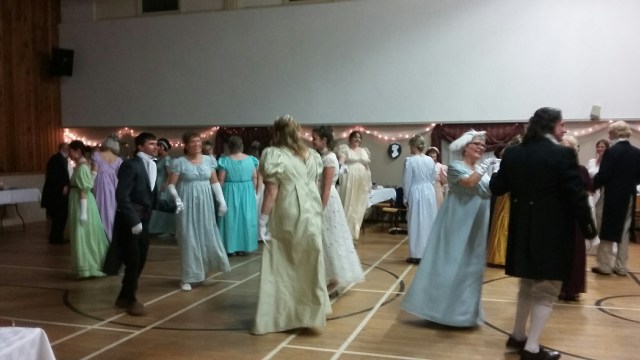
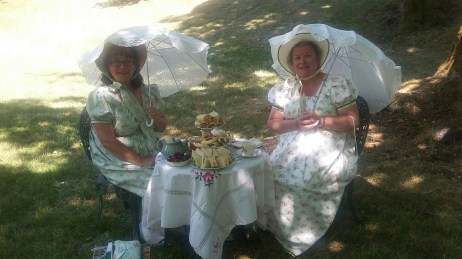 Saturday was a very full day, and I slept well that night. A picnic at a local park was the only thing on the schedule for Sunday. Some people went all out for that too, as you can see. Then it was time to do a little sightseeing before saying farewell to Port Alberni and all the friends we made there.
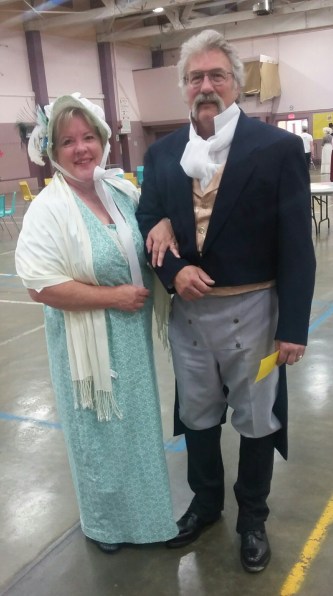 Yes, we had all the above: a great deal of enjoyment, novelty, beauty, and a fresh place that made an agreeable impression on me.
 “Miss Bennet,” replied her ladyship, in an angry tone, “you ought to know that I am not to be trifled with. But however insincere
  Dear Aunt,
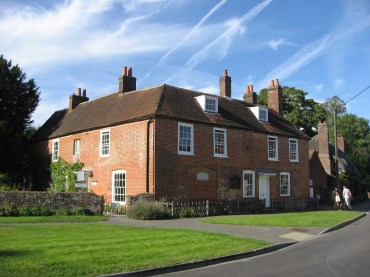 As some of you know, this year is the 200th anniversary of Jane Austen’s much-too-early death, and many of the faithful are noting events leading up to the end as they pass on the calendar. Yesterday (May 24th), for example, marked the day when Jane left her home in Chawton for what would turn out to be the last time, seeking medical help in Winchester, where she later died.
 Reading the recent posts about Jane’s move to Winchester (such as
  So, I said goodbye to my mother, knowing it would be, in all likelihood, the last time I would see her on this side of heaven, and I allowed myself to be carried off to Winchester. Cassandra travelled with me in my brother James’s carriage, with Henry and my nephew William riding escort alongside.
 We drove on to College Street, where we had arranged to rent rooms, but attaining those rooms was no easy task. In my dependent state, I had to nearly be carried up the narrow flight of stairs. I was especially glad for young William’s presence then, for it was an awkward business and I doubt as to Henry’s being able to have managed it on his own. Once more I apologised for my helplessness, and once more I was assured that my friends considered it a privilege to be of service to me.
 The best feature of our apartment was the neat little drawing room, which boasted a bow window with a view to the street, the old city wall, and Dr. Gabell’s garden. It was a pleasant room, but as I looked about myself I could not help wondering if I would ever leave that place again. Were those four walls, with the faded paisley paper peeling at the seams, the last sight my eyes would behold before closing forever? If so, the glories of heaven were sure to be the more impressive for the dramatic contrast.
 First, let me thank everyone who has already read one or both of my two new releases, Leap of Faith and Leap of Hope, especially those who have gone the extra mile and posted a review. I appreciate your confidence and support more than I can say!
 Two things Anne de Bourgh understood from a very early age: first, that she was loved by her father, and second, that she would one day marry Fitzwilliam Darcy.
 “My sister and I arranged it all between ourselves,” Lady Catherine frequently told her only child, sometimes varying her exact words but never her conclusion. “And the men mean to make no difficulty about it. When the time comes, you shall marry your cousin. It is not only the cherished wish of your mother and aunt, it is a solemn promise and therefore to be considered a settled engagement. The two great estates will thus be united in one family. There could be no connection more highly desirable on either side, no alliance more perfectly natural.”
 Today’s the opening day of baseball season! We’ve made it through that 2-month-long drought after Superbowl, where there was nothing to watch on TV, sports-wise, except soccer and basketball, neither of which interest me very much. Now, there will be a Mariners’ game on almost every night to keep me company while I clean up the kitchen, fold the laundry, or putter around on the internet. And just maybe this, at long last, will be Seattle’s year!
 For me, baseball is just one of many interests, a pleasant diversion, an undemanding entertainment – not my passion. But for someone aspiring to play the game professionally, it is serious business and, by necessity, an all-consuming passion. Nothing less than single-minded dedication would produce success in one of the most competitive sports on the planet.
 Baseball is a beautiful game, one that has been stitched into the fabric of my life since I began playing when I was eight years old. I spent seventeen years on the field and sixteen of them as a catcher behind home plate – a fitting name, for no matter which field, that patch of ground always feels like home to me.
 …But, looking back, was it all worth it? – the enormous effort and countless sacrifices made so I could play professional baseball?
 victory by the collective sum of their individual efforts.

 Now it’s time for me to go on book tour! – virtual book tour, that is, visiting several blogs this month as a guest blogger, all in an effort to get the word out about Leap of Faith and Leap of Hope to a wider audience. Along the way, I’ll be giving more books away (but you still have one day left to enter to win the biggest giveaway at the
  My big double launch day is finally here! And I do mean FINALLY. One of these two books has been waiting a very long time for its turn at publication.
 I’ve always been intrigued by the idea that a single choice in life can change everything that happens subsequently. For example, what if rather than choosing to go to college A, where you met your future spouse, you had selected college B? Would you have ended up marrying someone else instead, and consequently having different children? Yikes! Even a minor decision (such as where to eat lunch, what to order, or what route to take getting there) might make the difference between an ordinary day and winding up in the hospital from food poisoning or a car accident. Of course, being the romantic that I am, I’m thinking you might meet that certain someone wonderful in the hospital, which you never would have if you hadn’t gotten sick/injured. The possible variations are endless.
 At the Crossroads Center, they’re in the business of granting second chances. And their newest client is Ben Lewis, a former star athlete who never recovered from the death of his dream to make it big in the big leagues. Now he’s being offered the opportunity to return to 1991 and try again, this time without the illness that originally ended his baseball hopes. What’s the catch? He will pay for his second chance by forfeiting his memories of the first… and possibly along with them, the love of his life. Can he find his way home to the woman he’s long forgotten but never stopped missing? Or will reaching for the brass ring with both hands cause the treasure he once possessed to slip forever from his grasp?
 At the Crossroads Center, they’re in the business of handing out second chances. And their newest client is Hope O’Neil – college student and Jane Austen devotee, who has always believed she’d be more at home in the past, wearing corsets and courted by men in cravats. But can a modern girl really fit into a world with no electricity, cell phones, or indoor plumbing? Hope is about to find out when her wish for an Austen kind of life is unexpectedly granted. Although she envisions her second chance will be like something straight out of Pride and Prejudice – complete with her own Mr. Darcy and a romantic happy ending – she gets more than she bargained for in this delightful romp through Regency England… a lot more.

 Join me as I weave together my passion for writing and my love of all things Jane Austen. Please also look for me on Facebook.