 A few months back, I posed a question on Facebook about posting preview chapters of upcoming novels online. Did people like the practice or not? Did reading the opening chapters ahead of time make them more or less likely to purchase the book when it was finally published? That sort of thing.
Unfortunately, the results of my informal survey weren’t very conclusive. Some said the preview chapters got them hooked, and they would definitely want to get the rest as soon as it was available. Great! Others said that if they really got into the story, they became annoyed that they had to wait for the rest, frustrated that they couldn’t find out what happened right away. Not great.
 So this is what I decided – a compromise that I hope will make everybody happy. I am going to post chapters of my upcoming novel, The Ladies of Rosings Park, weekly at Austen Variations beginning this Monday, January 22 (follow this link). Read them if you wish or ignore them completely until the whole book becomes available. Your choice. Either way, it won’t be a long wait, because the novel should be out in early March.
In the meantime, I thought I’d give you a preview chapter of a different book here, one you may not have read yet. If this idea is a big hit, maybe I’ll continue on. But the point is, you don’t have to wait to read more since the book is already available!
 So here’s a specially selected chapter from Leap of Hope. Set up: Hope, a modern-day coed from the American south, has been granted her wish for an Austen kind of life (for now, never mind how this happened), and she has just been transported back in time to begin her second chance. She will be slipping into the shoes of a girl named Kathleen (Kate) Barrett, whose personality and situation are as much like another Lizzy Bennet as can be. Do you think Hope is prepared for all the differences and challenges of English Regency life? Would you be? She is depending on her Jane Austen knowledge to get her by until she can settle into her new life. She has to make this work because there’s no going back!
“Kate! Kate, can you hear me?”
I could hear the voice, but I couldn’t answer right away. Even though I remembered where I was supposed to be, I still didn’t quite believe it.
I must have viewed the scene a hundred times at the Center, forwards, backwards, and crossways: Lucy and Kathleen out for a sedate horseback ride on that fateful day. Then, Kathleen had suddenly taken it into her head to race away at top speed. I could see how exhilarated she was – laughing, with the wind blowing in her face – and I could relate.
It seemed a lot like something I might have done in her place. I always headed straight for the more extreme rides at any amusement park or county fair, and I admit to driving a little too fast with the windows rolled all the way down. So I could just as easily have been the one who met with disaster. Well… actually, I did meet with disaster; it just didn’t happen to be on account of my taking risks.
Anyway, Kathleen ignored the warnings her sister called after her and rode even faster. That’s when, as I saw it, she made her fatal mistake. Nearly at the last moment, she turned Horatio’s head to the left, steering him onto a trail that would take them through the woods. The gelding made the corner but Kathleen didn’t. It was horrible to watch. For a moment, she seemed to hang there in midair, half in and half out of the saddle. But gravity won out, like it always does. Over she went, tumbling toes over teakettle to the ground, landing on her behind and knocking her head.
That’s when the exchange was supposed to take place, with me slipping in just as Kathleen slipped away. I could swear we passed practically right through each other and that, just for a moment, she saw me. Maybe I only imagined it, but it seemed like she understood. I like to think so, anyhow.
“Kate! Kate, please wake up!”
This time I opened my eyes. There was the sky directly overhead where it should be – a puffy patchwork quilt of clouds in different shapes and shades – and to one side, a shadowy face hovering. The face gradually came into focus and connected to a body.
“Lucy?” I said. “Is that really you?” At least that’s what I tried to say. What actually came out of my mouth sounded like total gibberish, and then I guess I went unconscious again.
The next thing I knew, I was waking up in a very old-fashioned looking room, like something somebody’s great-grandmother might have thought was stylish back in the day. There was brown paisley print wallpaper, a picture rail all around, and no overhead light fixture where you’d expect to find one. It all seemed both familiar and unfamiliar at the same time.
I was flat on my back again like before, but this time at least, it was in a comfortable bed instead of on the hard ground. And now I had six worried faces staring at me instead of only one. The closest person was a youngish man, who I remember thinking was criminally handsome. He kept waving something nasty-smelling in front of my nose, though.
“She is coming round,” he said as he finally put that foul vial away. “How do you feel, Miss Barrett? Can you speak?”
I could not, not as Hope O’Neil or Kate Barrett either one. I had to get a firmer grip on reality before daring to open my mouth.
It seemed to be true, though. Everything had happened just as Cora and Poindexter had told me it would. I was alive as promised and presumably in 1809. This was Kathleen’s house, Kathleen’s room, and Kathleen’s family gathered around the bed, looking at me and seeing their beloved Kathleen. I recognized them all from my research. And the young man must be a doctor, I decided… or surgeon or apothecary or whatever the period-correct term might be.
I shouldn’t have been surprised. This is what I’d planned, after all, what I had asked for. But somehow I don’t think I had understood – not deep down, anyway – that it would actually come to pass.
“Kate, say something,” pleaded Lucy from the other side of the bed. “How are you?”
“I’m okay,” I managed before my hand flew up to cover my lips. Cora had warned me, but it had still been a shock to hear Kate’s voice coming out of my mouth!
“I’m okay?” repeated Mrs. Barrett as if the words were a foreign language to her. “How very odd. What can she mean by it? Mr. Cavanaugh, why is my daughter talking nonsense? Has she gone completely off her head?”
Darn! A mistake already! Ditch the contractions and no ‘okay’ either – too contemporary.
“It should not amaze me if your daughter were to say and do many odd things, Mrs. Barrett,” Mr. Cavanaugh replied, beginning to pack away his instruments in a small black case. “At least in the beginning. It is to be expected in cases of head injury. Not to worry.”
I exhaled a small sigh of relief, silently blessing the good doctor for his explanation. I didn’t necessarily like his tone – which immediately struck me as condescending, possibly bordering on contempt – but he had neatly excused my first error and conveniently established my alibi for all the others that would surely follow. Still, the sooner I got my head in the Regency game, the better. Time to break out that British accent I’d been secretly cultivating too. Choosing my words more carefully and preparing myself for the strange sound of my new voice, I tried again.
“I am well,” I said. “I have a little pain in my head; that is all.” Much better. I could do this. It would just take a little focus and a little practice.
I gazed around the circle at the Barretts, my eyes hungry to take them in for real this time. They were all there – Mr. and Mrs., Lucy, Carmen, and Matilda – in 3-D flesh, not just virtual on a screen anymore. This was my new family!… for better or worse, for richer or for poorer, forever and ever. And it was sort of like a marriage in that there was no going back. The strangest thing was my growing sensation that I had known them all a long time, much longer than the period of my research at Crossroads. Bits of brand new memory began popping into my head too. Looking at Matilda, I had a vivid impression of more than once watching her carefully choose a long, flat blade of grass from the garden to use as a bookmark. Where had that image come from? And Papa Barrett winking at me across the dinner table after a remark that amounted to a private joke between us.
These must be some of the ‘carryover’ memories Cora had talked about, things I inexplicably now knew just because Kathleen had known them before me. Perhaps she had handed them off to me as I slid past her on the exchange, like the baton in the relay races I used to run on the high school track team.
It was a little creepy on one level, considering that I was, more or less, inhabiting the skin of another person, the skin of a dead person at that. Probably better not to think about it too much, I decided. It was just one of those mysteries of life we weren’t meant to understand, like how the universe is infinite or why some women can wear hats and others just look ridiculous.
The more of Kathleen’s memories I recovered, the better; that was the practical point. There would be less groping around in the dark that way, and a lot less stumbling into gopher holes.
Even the stern but distinguished-looking doctor in front of me began to seem familiar, although I couldn’t imagine why. I was sure I’d never run across him in my research. Not even once. That particular flavor of sweetmeat I would have remembered. He was still staring at me, now with one eyebrow lifted, like he was challenging me to say something.
Then he turned to speak to the others. “I believe Miss Kathleen is out of danger,” he said. “Rest is the best thing for her, so if you would be so kind…” He stood, towering over the bed, and began ushering Barrett after Barrett towards the door with a definite air of authority.
I did say something then. “I desire that Lucy should stay with me for a while,” I declared, proud of how I had phrased it. It sounded very Regency-ish to me. At the same time, I reached for my new sister’s hand, thinking it’s what Kathleen would have done.
Lucy smiled tenderly down at me. “May I, Mr. Cavanaugh?” she asked.
“By all means. Someone should probably sit with the patient for the first four-and-twenty hours or so, just to watch for any sign of trouble. I myself had best be getting on, but I will return first thing tomorrow. Sooner if I am needed. Will that be acceptable to you?”
He directed this last bit at me, that is to say Kathleen, with a serious look. I hardly knew how to respond, so I just nodded. Apparently satisfied, the doctor went away, leaving Lucy and me alone.
“Oh, Kate,” Lucy began, still holding my hand, “what a fright you have given us! When I saw you slip from Horatio’s back, I thought for sure I had lost you forever.”
“Did I strike my head?”
“Oh, yes! There happened to be this great stone exactly where you fell. There was so much blood, and then you lay still for the longest time. I hardly knew what to do. I thought perhaps I should ride for help, but I could not bear to leave you. So I screamed at the top of my lungs, hoping against hope that someone would hear and come to my aid.”
“And did someone?”
“He did! A stranger, although I daresay he will be a stranger no longer. It was Mr. Sotheby, the new owner of Coleswold. Just think, Kate! It was only this morning we were discussing how we could contrive a way to meet our neighbor, and now he has been introduced to our family in such an unexpected fashion!” She then hastened to add, “Of course I should have much preferred it had been by ordinary means. Surely Papa would have eventually relented and done what was required, or we might easily have been introduced at a ball.”
“But wasn’t it clever of me to expedite matters by throwing myself from my horse?” I suggested, trying out my best British accent. “Now you must tell me all about this Mr. Sotheby, for I was quite unconscious, you will recall.”
Although I believe Lucy Barrett was as solicitous for my health as any sister could possibly be, she was equally enthusiastic for the subject I had suggested. Once I had assured her I was not too tired to hear it, she launched into an animated recital of Mr. Sotheby’s merits in impressive detail. He was rumored to be rich. Most importantly, though, he was definitely single. Lucy had cleverly induced him to give up this information. He must also be handsome, I suspected, judging from the way she was blushing as she talked about him. His gallantry could not be doubted, considering how he had managed to be around just when help was needed.
“And he is so strong!” Lucy continued, breathlessly.
“A definite virtue in a man.”
“He lifted you so easily, as if… as if…”
I could not resist filling in the blank from my own frame of reference. “As if I weighed no more than a dried leaf?”
“Yes, it was exactly so! How well you have captured the idea! And then he carried you all the way home without becoming the least bit tired. It is unfortunate that you were deprived of seeing it for yourself.”
“Unfortunate, yes, but if I had been awake, there may have been no need.”
Lucy laughed. “I suppose you are right.”
“I can imagine, though. I have witnessed such things before,” I added, thinking of that rain-drenched scene in my favorite film version of Sense and Sensibility.
“Have you? When?”
“Oh, never mind about that now. Tell me more of Mr. Sotheby. And what of this Mr. Cavanaugh? His manner implied some level of acquaintance, but I really cannot at this moment remember.” Here, I closed my eyes and reached one hand to the back of my bandage-wreathed head to reestablish the reason for my lack of recollection.
“You poor darling!” Lucy cooed. “I suppose it will come back to you in time, but let me help you along a little. You met Mr. Cavanaugh at the most recent assembly, where you refused to dance with him, I might add.”
No wonder, then, that he seemed none too friendly. “But why would I refuse such a reasonable request? Did I say? I love to dance, after all, and there is nothing objectionable in his looks.”
“Nothing whatever! He is such a fine figure of a man. No, you told me it was something else that did not suit you. Something you overheard him say, although I cannot now recall what it was.”
But suddenly I did recall – another carryover memory. Mr. Cavanaugh had been speaking to some gentleman or other when Kathleen happened to be passing unnoticed behind them.
“In truth, I find these country assemblies more punishment than pleasure,” he had declared, clear as anything. “One feels obligated to dance with every mother’s daughter sitting down in want of a partner, no matter how undesirable. Really, I sometimes think these affairs are more irksome than even the ‘marriage market’ balls of the London season. It is the same everywhere; if one has a tolerable fortune, one is considered fair game for every husband-hunting miss in the country.”
How rude! How very Mr. Darcy-ish of him (the Darcy before Lizzy taught him the error of his ways, that is). No one could blame Kathleen for refusing to dance with the man after that!
And then I remembered something else I (Kathleen) had heard at the same assembly. “You were quite right to cut the man, deary,” an older lady standing nearby told me. “I wonder that the man has the nerve to show his face among us after what he did to poor Mrs. Conner, may she rest in peace. Imagine, refusing to come when she sent for him, all because she had no money to pay.”
Kathleen had seen Mr. Cavanaugh for what he was that night. Now it was my clear duty to go on disliking him in Kathleen’s place, out of loyalty to her and on principle. He probably only bothered to attend me because my father had enough money to pay him well.
With this new information in mind, I announced to Lucy, “He’s a conceited snob, stuck up higher than a light pole.”
“A what?” she asked.
“Oh… I mean… I mean that he gives himself airs,” I corrected. “He thinks too well of himself, above his company. And who is he, after all? Only a doctor.” My outburst had been another mistake, but at least I had remembered that doctors had no special status here.
“Now, Kate,” Lucy chided, “Mr. Cavanaugh is a gentleman from a very good family, we are told. I hope you do not intend holding the fact that he also has a profession against him. Really, I think it quite commendable that he should want to do something useful with his time. There are far too many idle young men about as it is. So I said before and you agreed with me. Do you really not remember, dearest?”
“It’s coming back to me, little by little. So you have a high opinion of this Mr. Cavanaugh as well as the handsome Mr. Sotheby.” This reminding me of another Austen reference, I asked, “Do you never see a fault in anybody, Jane? All the world are good and agreeable in your eyes, I suppose.”
“Jane?” Lucy repeated, her brows drawn together with confusion. “You know my name as well as your own, Kate. You had better rest, as Mr. Cavanaugh recommended. That will no doubt set your brain to rights. I will sit with you a while, but you must close your eyes now.”
I humbly obeyed, relieved to have an excuse to shut my big, fat mouth too. I had begun feeling at home in my new role, to enjoy being in character, so much so that I let down my guard. And look what happened!
When Lucy described our handsome new neighbor coming to rescue ladies in distress, I had pictured Willoughby sweeping Marianne up into his arms. And when Lucy spoke so favorably of Mr. Cavanaugh and Mr. Sotheby both, I had heard Jane Bennet’s voice.
Although I was tickled beyond anything to finally be a living, breathing part of the culture that had inspired the Regency stories I loved so much, ideas like this were bound to keep popping into my head. How was I supposed to stop them popping out of my mouth? That was the question. It seemed like this was going to be harder than I’d expected since everywhere I turned I was sure to see something that would remind me of Austen – her books and the movies made from them. My mistakes might be blamed on my accident for a while, but not forever.
Keep your head in the game, Hope, I coached. Then I reminded myself of one more very important fact. There was no more Hope; I was Kathleen now.
I Hope you enjoyed your sample chapter from Leap of Hope! Leave a comment about it or how you feel about the practice of posting preview chapters, and have a great day!
His person and air were equal to what her fancy had ever drawn for the hero of a favourite story… (Sense and Sensibility, chapter 9)

 Today, though, I want to share the first part of what I’ve written for the NA sequel, proposed title: Midnight at Northanger Abbey. [Update: final title is Murder at Northanger Abbey] Be sure to let me know what you think!
 But in fact, love and adventure did find her, as she had always foreseen. It was only now, some time afterward that she had difficulty believing it. Parts of the story began to feel like an implausible dream: those early heady days exploring Bath with the inconstant Isabella Thorpe, being introduced to Henry at the assembly rooms completely by chance, her uneven acquaintance with the rest of his family, the surprising invitation to Northanger Abbey, and finally her violent expulsion from that place with Henry following, resolved on marrying her.
 Three years ago, I did a post on
  The Boys in the Boat, by Daniel James Brown
 by Jacqueline Kelly
![I've Got Your Number: A Novel by [Kinsella, Sophie]](https://images-na.ssl-images-amazon.com/images/I/41BJVwKQkoL.jpg) I’ve Got Your Number, by Sophie Kinsella
I’ve Got Your Number, by Sophie Kinsella![Me Before You: A Novel by [Moyes, Jojo]](https://images-na.ssl-images-amazon.com/images/I/51EbPCigZgL.jpg) Me Before You, by Jojo Moyes
Me Before You, by Jojo Moyes![The Rosie Project: A Novel (Don Tillman Book 1) by [Simsion, Graeme]](https://images-na.ssl-images-amazon.com/images/I/51zS47EOayL.jpg) The Rosie Project, by Graeme Simsion
The Rosie Project, by Graeme Simsion Phew! It was a lot of work, but The Ladies of Rosings Park is successfully launched and doing well. Thank you to those of you who have taken the time to post early reviews. When you really enjoy a book, that is the best thank-you you can give its author!
 One of my long-range goals is to write at least one novel related to each of Jane Austen’s six. Obviously, I’ve got Pride and Prejudice covered, and whatever else I do is bonus material. The Persuasion of Miss Jane Austen takes care of Persuasion. I count Leap of Hope as my Mansfield Park book, even though it has elements of the others too, especially P&P. But that still leaves three to go, plus a few additional ideas I have.
 s it possible to have too many Williams? I like the name – very much, in fact. Even so, there ought to be a limit as to number.
 The two Fitzwilliams I understand; Darcy was christened with his mother’s maiden name, which, naturally, is also his cousin’s last name. Probably a common practice at the time (and something I actually carried forward to the next generation by naming D&E’s son “Bennet” in The Darcys of Pemberley). In truth, there really wasn’t any confusion in the original story. Fitzwilliam Darcy is “Mr. Darcy” to one and all, and Colonel Fitzwilliam is either “Fitzwilliam” or “Colonel.” Mr. Collins is always just “Mr. Collins,” and Sir William Lucas, a minor character, is referred to as “Sir” William. That was clear enough.
 ran into trouble right away, however, when I began writing my first sequel (The Darcys of Pemberley). Although Elizabeth might continue calling her husband “Mr. Darcy” in formal situations (just as Mrs. Bennet did with Mr. Bennet in P&P), she probably wouldn’t in the comfort of their own home and family. She would probably have called him Fitzwilliam. But then what happens when Colonel Fitzwilliam shows up? Since he was a major player in the story as well, I had to come up with a solution, or there would be a lot of awkward conversations. Elizabeth says, “Fitzwilliam, do you agree with Fitzwilliam’s position on the subject?” Then one of the gentlemen called Fitzwilliam answers, but we’re not sure which one it is!
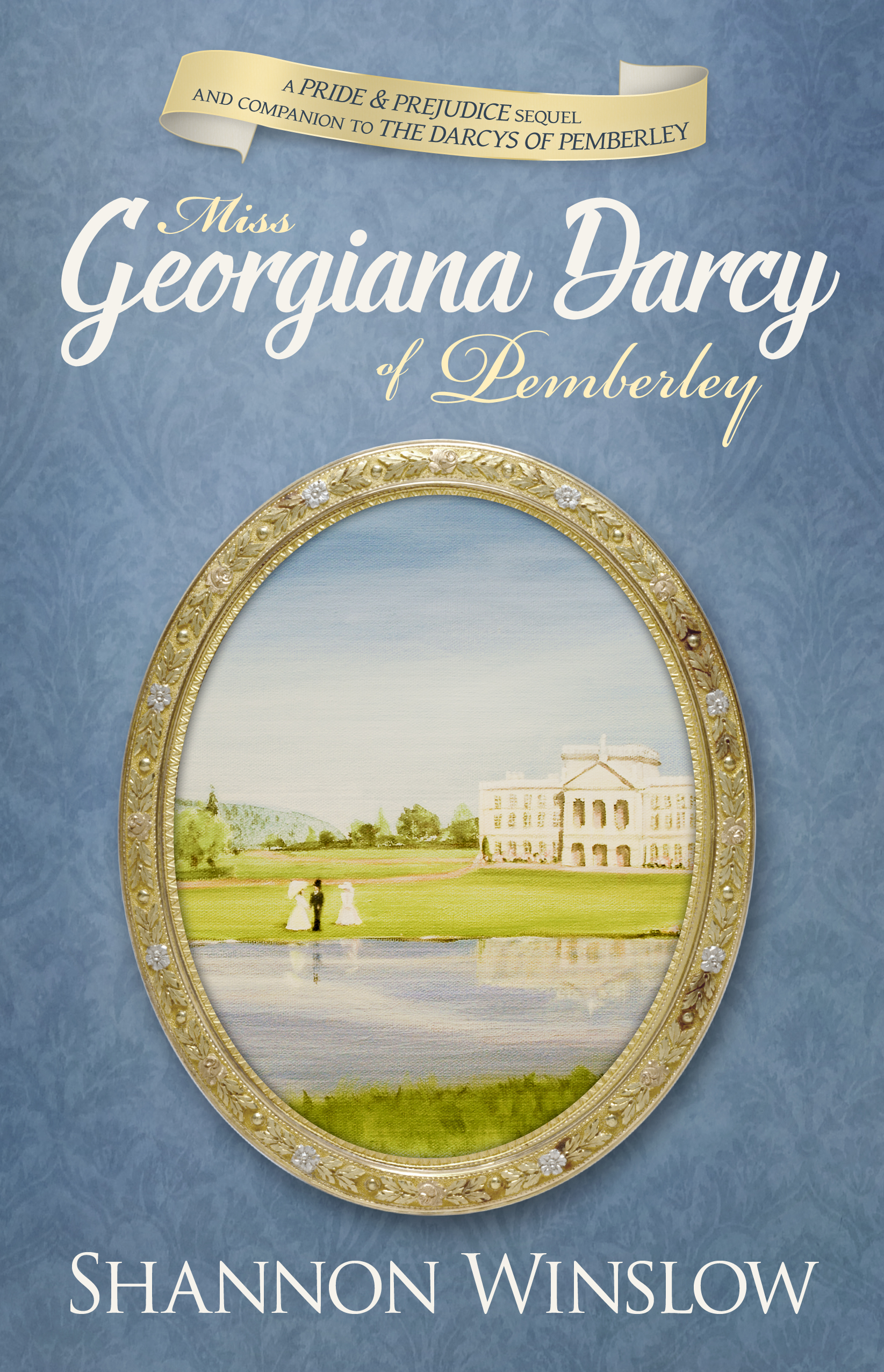 But when I started Miss Georgiana Darcy of Pemberley, the difficulty only got worse. It’s written in first person from Georgiana’s point of view, and she would be constantly referring to her brother in thought and dialogue. So what was she going to call him? I might get away with “Darcy” for Elizabeth, but not for Georgiana! Once again, she couldn’t refer to him as “Fitzwilliam” because the other Fitzwilliam would feature even more prominently in this book than in my first. And although I had sidestepped the issue in TDOP by having Georgiana use “Brother” on the few necessary occasions, I couldn’t go on like that through the length on an entire novel! No.
 Late in the story, however, Sir William Lucas enters the action and shows up at the same place and time as the other two men. Now I have a new variation of the original dilemma. Instead of two Fitzwilliams, I have two Williams! It took some fancy footwork to maneuver through that scene without confusion and without endless repeats of the names William, Sir William, and Fitzwilliam. Here’s an excerpt, in Georgiana’s words:
 Another variation of the same challenge confronted me with my latest novel, The Ladies of Rosings Park (due out early next year), which is written primarily from Lady Catherine’s and Anne de Bourgh’s points of view. In P&P, Lady Catherine calls her nephews “Darcy” and “Fitzwilliam,” but I couldn’t imagine their younger cousin doing the same. And Anne has no lines of dialogue in the book for Jane Austen to set me a precedent. I decided that Anne would follow Georgiana’s example. She calls Mr. Darcy “William,” and Colonel Fitzwilliam she calls “John” – his given name in my books. (Here is another possible source of confusion, since many other JAFF writers have settled on “Richard” instead! Jane Austen doesn’t tell us.)
 I have no choice with a sequel; I need to do the best I can with the cast of character names I have inherited from the original. And you would think I’d have learned my lesson in the process. But I actually set myself a bigger challenge in The Persuasion of Miss Jane Austen, where I wrote two stories running parallel – what was happening in Jane’s own life set alongside what she described in Persuasion as a reflection of it. I had two of everything: two heroines (Anne and Jane), two captains (Wentworth and Devereaux), and two admirals (Croft and Crowe). The admirals were the hardest to keep straight because of the similarity of names. Argggh! And no one to blame this time but myself.
 CH: Admiration for her intelligence and character, as reflected in her books and letters. I was wowed by what her brother Henry called “the extraordinary endowments of her mind.” I didn’t want to steal from her—at least not very much—but I did want to make use of her qualities in a meaningful way. In parallel, I had begun work on a general story of a woman set in the early 1800s, and I realized that the voice kept morphing into Austen’s. When I dived deeper into the details of her life, I realized I could combine her personal story with the major events of the Regency era in a way that stayed true to both.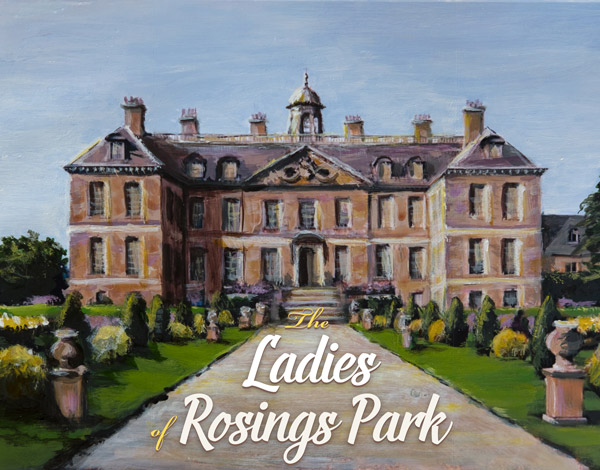
 When I mentioned on Facebook that I was writing the scene where Anne de Bourgh crashes Georgiana Darcy’s 18th birthday ball (for my work-in-progress, The Ladies of Rosings Park), I started to receive comments from enthusiastic friends about what they thought that scene should contain – creative suggestions I wished I could use for the book but couldn’t, since the book has to match the tone of Pride and Prejudice. Then I had this messaging conversation:
 Recalling herself from her musings, Anne smoothed her gown, struck an elegant pose, and looked about herself. What she saw was a party in full swing. The dancing had not begun, and yet the well-turned-out throng of people had already commenced carrying on. Their spirits were very high indeed, and it seemed that the largest bowl of punch she had ever seen was at the center of it all. What was in that punch, she wondered?
 The birthday girl replied, “Oh, Lizzy, I could not bear all those people looking at me any longer – the women wanting to find a flaw and the men hoping to win my fortune. Greetings, Cousin Anne,” she continued, going to shake her hand. “So nice of you to come. It has been ever so long, and my, how extremely well you look!”
 Thus fortified, the three women did just that. Miss Darcy soon discovered she was not as nervous as before, and Miss de Bourgh found the amorous gentlemen much more easily managed since Elizabeth had scolded them. They both danced and danced.
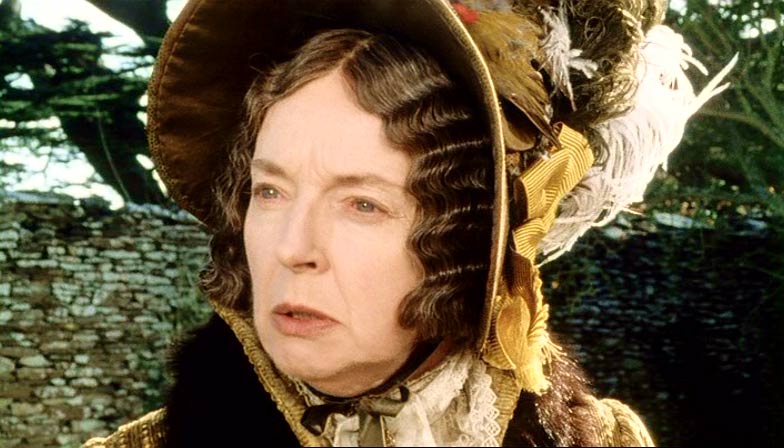 During the supper break, another scuffle was heard in the hall, followed by indignant words. “Unhand me, Henderson! You forget yourself. I am here to collect my daughter, and I will not be prevented!”
 Join me as I weave together my passion for writing and my love of all things Jane Austen. Please also look for me on Facebook.