
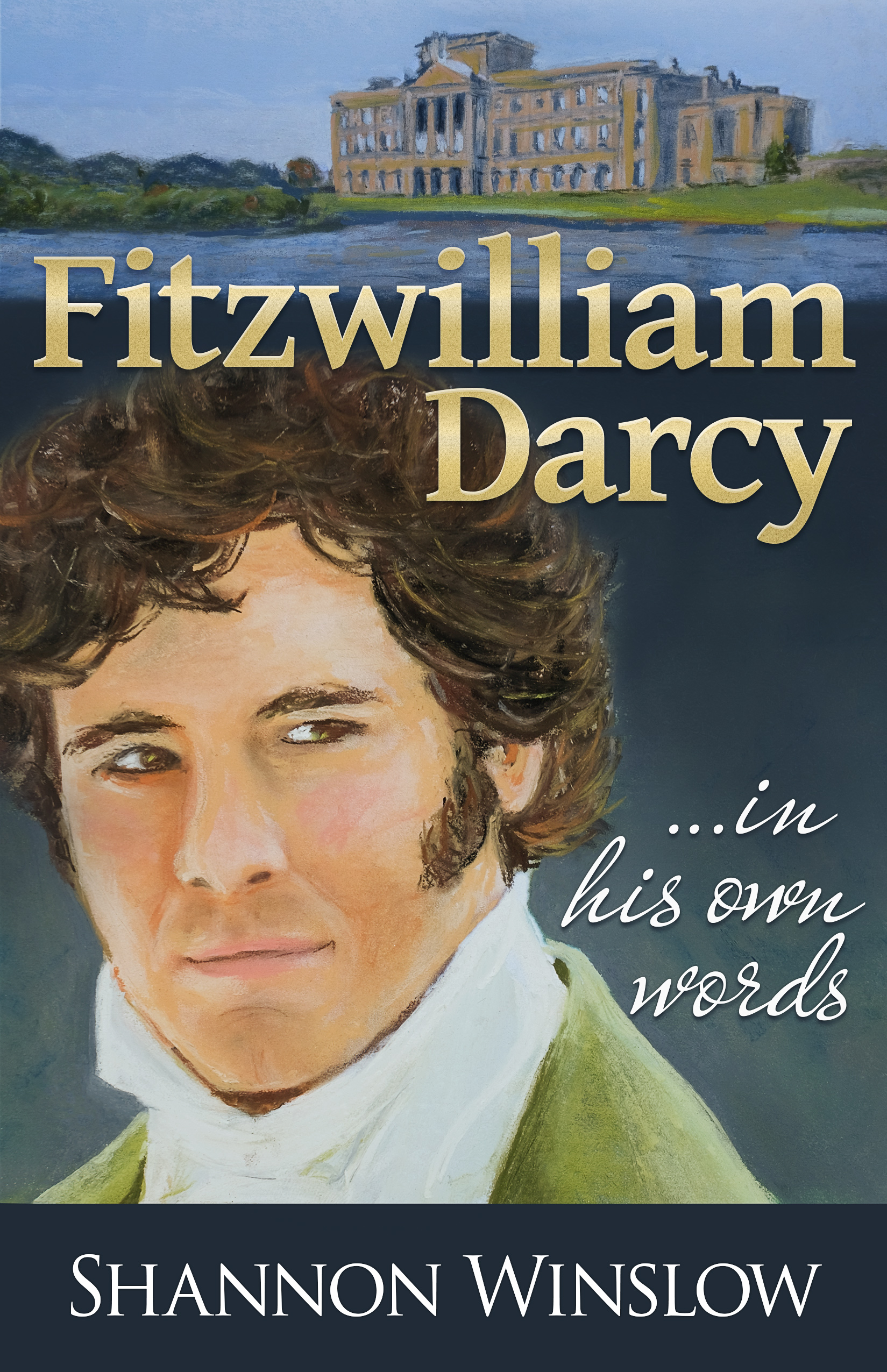
It’s here at last! I’m excited and proud to introduce my latest novel to you: Fitzwilliam Darcy in His Own Words.
When one online friend heard that my new book was coming out on Star Wars Day (“May the 4th be with you.”), she said she fully expected it to be a Pride and Prejudice / Star Wars mash-up. Sorry. Cool idea. Maybe a short story someday.
But, no, Fitzwilliam Darcy in His Own Words is pure, unadulterated Pride and Prejudice – unadulterated, that is, in the sense that Austen’s original story remains unchanged. But I have added a treasure trove of previously undisclosed information to it, including revealing the behind-the-scenes love triangle that threatened to completely and permanently change the outcome! So is this novel a variation or not? Yes and no. It’s part prequel, a ton of “missing scenes” material and all of it in an alternate character’s point of view: that of our favorite hero, Fitzwilliam Darcy.
It was tremendous fun writing this book! -getting inside Darcy’s head, discovering what he was thinking and what he was up to all that time. I hope you will enjoy reading his story too! So, without further ado, here’s the book blurb, followed by the slightly shocking Prologue in Darcy’s Own Words:
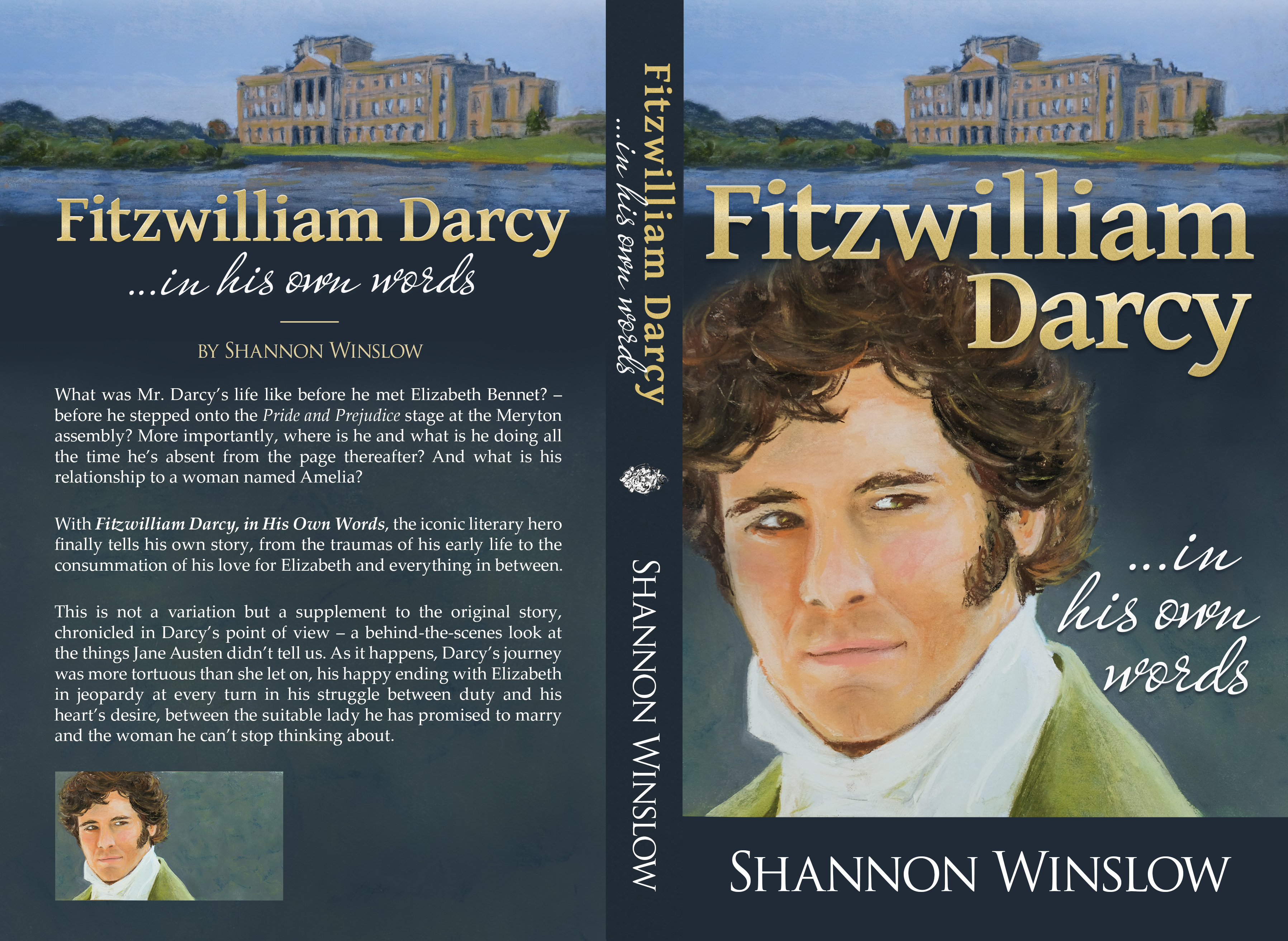
What was Mr. Darcy’s life like before he met Elizabeth Bennet? – before he stepped onto the Pride and Prejudice stage at the Meryton assembly? More importantly, where is he and what is he doing all the time he’s absent from the page thereafter? And what is his relationship to a woman named Amelia?
With Fitzwilliam Darcy, in His Own Words, the iconic literary hero finally tells his own story, from the traumas of his early life to the consummation of his love for Elizabeth and everything in between.
This is not a variation but a supplement to the original story, chronicled in Darcy’s point of view – a behind-the-scenes look at the things Jane Austen didn’t tell us. As it happens, Darcy’s journey was more tortuous than she let on, his happy ending with Elizabeth in jeopardy at every turn in his struggle between duty and his heart’s desire, between the suitable lady he has promised to marry and the woman he can’t stop thinking about.
Prologue:
I still occasionally suffer that recurrent dream – a nightmare, really. I awake at Darcy House in London. Morning light is filtering through the diaphanous draperies at the windows, painting ghostly shadow patterns across the opposite wall. I feel a great sense of wellbeing at the start of a new day. All is right with the world, or at least my portion of it.
Then I turn toward the other side of the bed and see… not Elizabeth, as I expect, but the Honorable Miss Amelia Lambright. Only of course she is no longer an honorable miss, not when she has spent the night in a man’s bed. Then I suddenly remember why she is there. Her name is Miss Lambright no more; she is Mrs. Darcy now. My heart lurches and I break into a cold sweat, not because the former Miss Lambright is so horridly unappealing, but because she is not Elizabeth.
I tell myself it surely must be a hallucination or some trick of the light. So I shake my head to clear any cobwebs, rub my eyes, and blink. Still, the wrong woman is before me. Please, God, let it be a dream!
I fight to awaken, to claw my way back to the world where I belong, the world where Mrs. Darcy has not blonde but dark, sat-iny hair and sparkling eyes. My throat constricts; I cannot breathe. I cannot find my voice to call out. Elizabeth, where are you? I must find her! My life depends on it.
When on these disturbing occasions I at last come to myself, it is many minutes before my heart and breathing return to normal, and longer still until my mind can quiet itself. Even after I have verified that Elizabeth is indeed beside me where she belongs; beheld her face, a peaceful portrait of repose in whatever meager light offers; pulled her warm, familiar form to fit close against mine; and heard her sleepy but unmistakable voice murmuring my name with affection…
Even then my soul quakes within me for how close the vision from which I have just awakened came to being true, how close I came to missing Elizabeth altogether. Then she and I would have been only two ships sailing the same stretch of sea, perhaps even passing within sight of each other occasionally but never hap-pening to come into a common port together, at least not until it had been too late.
My happier outcome depended on the slimmest thread of unlikely circumstances being precariously strung together without error. At any one of a dozen junctures, the course of my life could have carried me in a completely different direction.
When I consider this, I shudder. Then I thank God for His providential care in guiding me safely through. I thank Bingley for Netherfield. And Wickham. Strangely enough, now, years later, I can think back with some philosophy, enough to acknowledge the part he unwittingly played. Were it not for Wickham and his nefarious but timely interventions, I would likely be married to Amelia Lambright today.
Intrigued? I hope so! Fitzwilliam Darcy in His Own Words is available NOW in paperback, Kindle, and KU. Want it in audio? I’m delighted to tell you that the incomparable Harry Frost is currently recording the book! It should be out the end of June or in July.
Meanwhile, watch for the limited blog tour stops I have planned for more about the book, excerpts, and humorous interviews (featuring a disgruntled Mr. Collins and an aloof Mr. Darcy).


 Fitzwilliam Darcy, in His Own Words. The book is done, and I can hardly wait for its debut on May 4th. I’m super excited about the gorgeous cover too (inspired by this still from the ’95 mini-series), which is scheduled to be revealed on April 14th. But that’s still over 3 weeks away!
 And now, as I promised, here’s that graphic I created to give you a peek-a-boo look at the cover. What do you think? – not the bricks, of course, but the pair of eyes looking at you between them. I have to admit I had fun putting this together. 😀
 4/14/21 UPDATE: Here’s the finished cover! I hope you like it. Everything is on track for the May 4th publication of Fitzwilliam Darcy in His Own Words in Kindle, KU, and paperback. It’s available now at


 2020 is winding down, and considering all the troubles we’ve had this year, I think there are few who will be sorry to see it end. But it hasn’t been all bad. We’ve learned new things, like how to conduct a Zoom meeting and how to wear a face mask properly. (Well, let’s be honest, a lot of folks still haven’t learned that one yet!) We’ve learned to be infinitely creative and that it’s possible to do things differently and still get by.
 So, I’ve made another adjustment, in this case to how I spend a couple of hours each evening, by combining two of my favorite hobbies into one. With no TV, my new wind-down, decompression routine is listening to audio books while I solve online jigsaw puzzles. Extra reading is probably a better use of my time anyway!





:no_upscale()/cdn.vox-cdn.com/uploads/chorus_asset/file/8852431/senseandsensibility2.jpg)

 Thank you! All your positive feedback on my previous post (
 The only situation in Darcy’s prior life that we know very much about from P&P is Wickham’s attempted elopement with Georgiana. Since this event falls within the scope of my work-in-progress, I took another look at D’s letter to E, where it’s spoken of:
 Nevertheless, there it was in black and white: I wrote to Wickham. And since I’m only adding to, not changing, the original story, a letter from Darcy to Wickham I must write!
 Audio Book Update – In case you haven’t heard yet, Leap of Hope is available in
  Join me as I weave together my passion for writing and my love of all things Jane Austen. Please also look for me on Facebook.




 Shannon Winslow's "Jane Austen Says..."