
For the last month, I’ve been busy with the blog tour launching my latest novel: Murder at Northanger Abbey (see previous post). Someday I’d like to do a “real” book tour, like authors used to. But I suppose it’s just as well this one was designed to be “virtual” instead, because in the current Covid crisis, it wouldn’t have worked for me to travel all the places I’ve visited – various destinations in the US, plus England, Italy, and Portugal – meeting lots of people and signing books in person.
Next up? I have just a few chapters written so far of another P&P book, this one from Mr. Darcy’s point of view. Also, I have not one but two audio books in production! Leap of Hope is already recorded and just needs to go through the editing process. And Murder at Northanger Abbey will hopefully follow close behind. I adore audio books myself, and so it’s a real thrill for me to be able to offer so many of my own in that format!
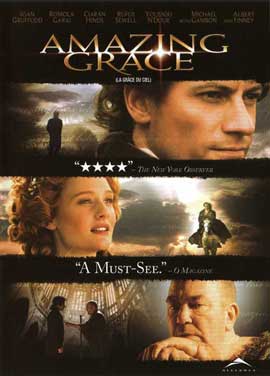 Now, on to the main topic of this post: the movie Amazing Grace. I first saw this excellent movie several years ago, but current events got me thinking about (and watching) it again.
As you may or may not know, there has recently been some thought-provoking discussion within Jane Austen circles about the presence and the role of non-whites in Regency England. And some very informative articles on the subject have been posted at Jane Austen Variations by my fellow authors over the last few weeks. I will not attempt to duplicate all their fine work, only invite you to read more here and here.
For today, I’ll just reiterate that Regency England was not as homogeneously Caucasian as people often suppose. There were small yet significant numbers of people of color living in England at the time, even some in high position. Jane Austen herself included a mixed race heiress in her unfinished novel Sanditon (expanded into a recently-aired mini-series):
Of these three, and indeed of all, Miss Lambe was beyond comparison the most important and precious, as she paid in proportion to her fortune. She was about seventeen, half mulatto, chilly and tender, had a maid of her own, was to have the best room in the lodgings, and was always of the first consequence in every plan … (Sanditon)
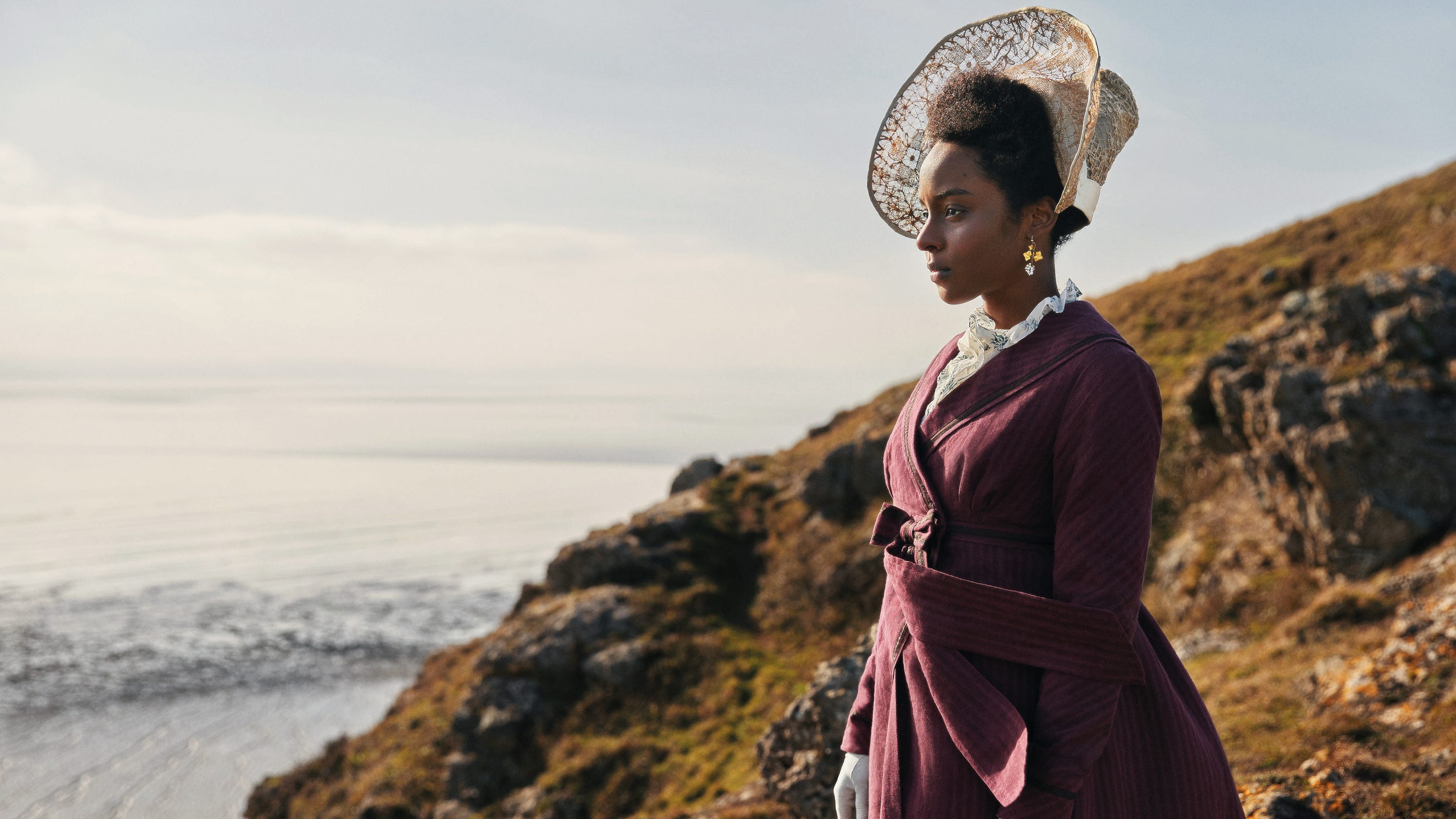 My point is that Jane Austen must have had at least some exposure to people of other races. And although she never addressed wars and political movements head on in her novels, she, and her characters likewise, were not unaware of the major issues of the day, one of those (arguably the most significant) being the debate over abolishing the slave trade that generated so much wealth for the British empire and many of its upper class families, and which is also the subject of Amazing Grace.
The topic is mentioned in passing at least twice in Austen’s novels. In Mansfield Park, Fanny tells Edmund, “But I talk to [my uncle] more than I used. I am sure I do. Did not you hear me ask him about the slave-trade last night?” In Emma, Mrs. Elton exclaims to Jane Fairfax, “Oh! my dear, human flesh! You quite shock me; if you mean a fling at the slave-trade, I assure you Mr. Suckling was always rather a friend to the abolition.”
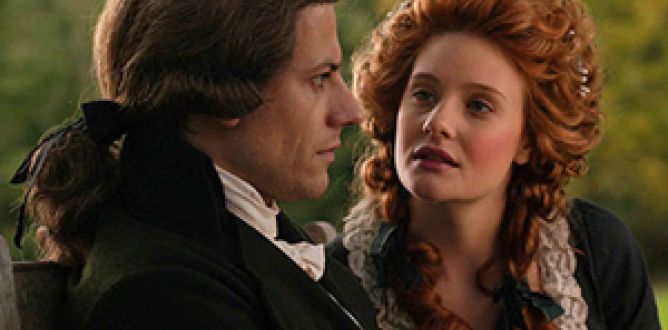 Amazing Grace (2006) is based on the true story of William Wilberforce (Ioan Gruffudd) and his passionate, courageous, decades-long quest to end British sanction of and participation in the slave trade, a quest that is ultimately successful. Along the way, he faces intense opposition, but he also finds formidable allies in the fight:
 John Newton (Albert Finney), a reformed slave ship captain turned Christian minister, who penned the beloved hymn that gives the movie its title.
William Pitt (Benedict Cumberbatch) Wilberforce’s college friend and the youngest prime minister ever.
Barbara Spooner (Ramola Garai) a staunch abolitionist who becomes Willberforce’s wife.
Lord Charles Fox (Michael Gambon) a powerful and unlikely parliamentary ally.
Thomas Clarkson (Rufus Sewell) a radical abolitionist ready for revolution, if necessary.
 Olaudah Equiano (Youssou N’Dour) a former slave who purchased his own freedom and went on to publish his compelling and hugely successful autobiography depicting the horrors of slavery.
And others, many of the Quaker faith. So while William Wilberforce took the fight to parliament, people from various backgrounds and walks of life worked tirelessly with him, together changing the tide of public opinion and the course of history.
Ioan Gruffud delivers a brilliant performance as Wilberforce. And as you can see, the rest of the cast is stacked from top to bottom with nothing but the best dramatic talent. You can add to this list another old friend from Persuasion ’95: Ciaran Hinds in a less-sympathetic, less-heroic role this time, as Lord Tarleton, an outspokenly pro-slave-trade MP.
As with any dramatization, significant creative licence has no doubt been taken, but my understanding is that the story line follows historical facts pretty closely. And some parts – portions of Wilberforce’s speeches, for example – are taken directly from preserved parliamentary records, etc. That’s the case with the caption in the picture below – what Lord Charles Fox said of Wilberforce when the battle in parliament was finally won.
 All this took place during Jane Austen’s lifetime.
No movie can be all things to all people. Obviously, no movie can tell every aspect of such a complex, far-reaching, generations-long, globe-spanning issue as slavery. But Amazing Grace does an amazingly good job of illuminating the particular aspect of the story that is its focus: the atrocity of the slave trade and the political fight to end British involvement in it. That is an important story that deserves to be told, heard, and remembered. Amazing Grace is a must-see movie on those grounds alone, even aside from the fact that it is a tremendously well-made film.
Interested in my other movie reviews? Visit my Movie Reviews page for the complete list with links.
 The day is finally here! Maybe some of you have been waiting impatiently for Murder at Northanger Abbey to come out. Believe me, I have too!
 To be more specific could be considered a spoiler, even though the answer is revealed early in the book. So I will leave it up to you if you want to know now or not. If you do, you will find the answer at the bottom of the launch post running concurrently at
 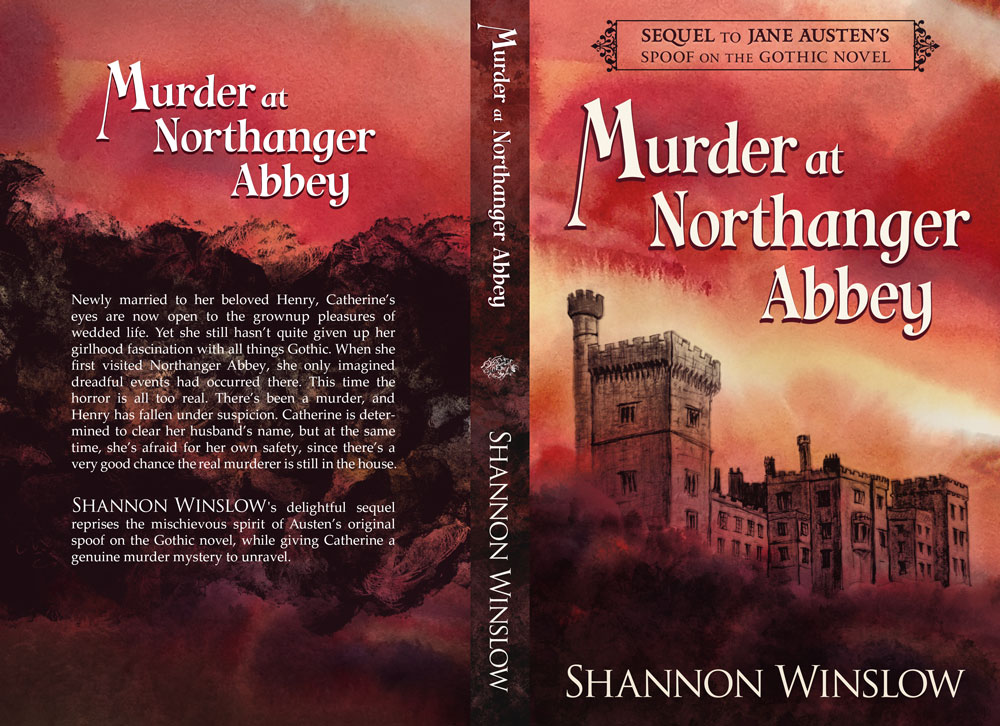 I’d never written a murder mystery before, but that seemed the only choice for a sequel to Northanger Abbey. So I went for it, taking an unconventional approach. You see, unlike most writers of the genre, I didn’t decide “who done it” until I was halfway through the book. Not my fault, really; there were just so many good suspects to choose from! Think Gosford Park: lots of people in the house and everybody has a motive. Anyway, you’ll have to read for yourself to see who the real culprit (and the victim) turn out to be!
 Things are on track for a June 23rd release of my next novel! Yay! All four of my beta readers have reported back with very positive feedback and no major changes recommended. Now just a proof read, formatting, and the final touches to the cover remain!
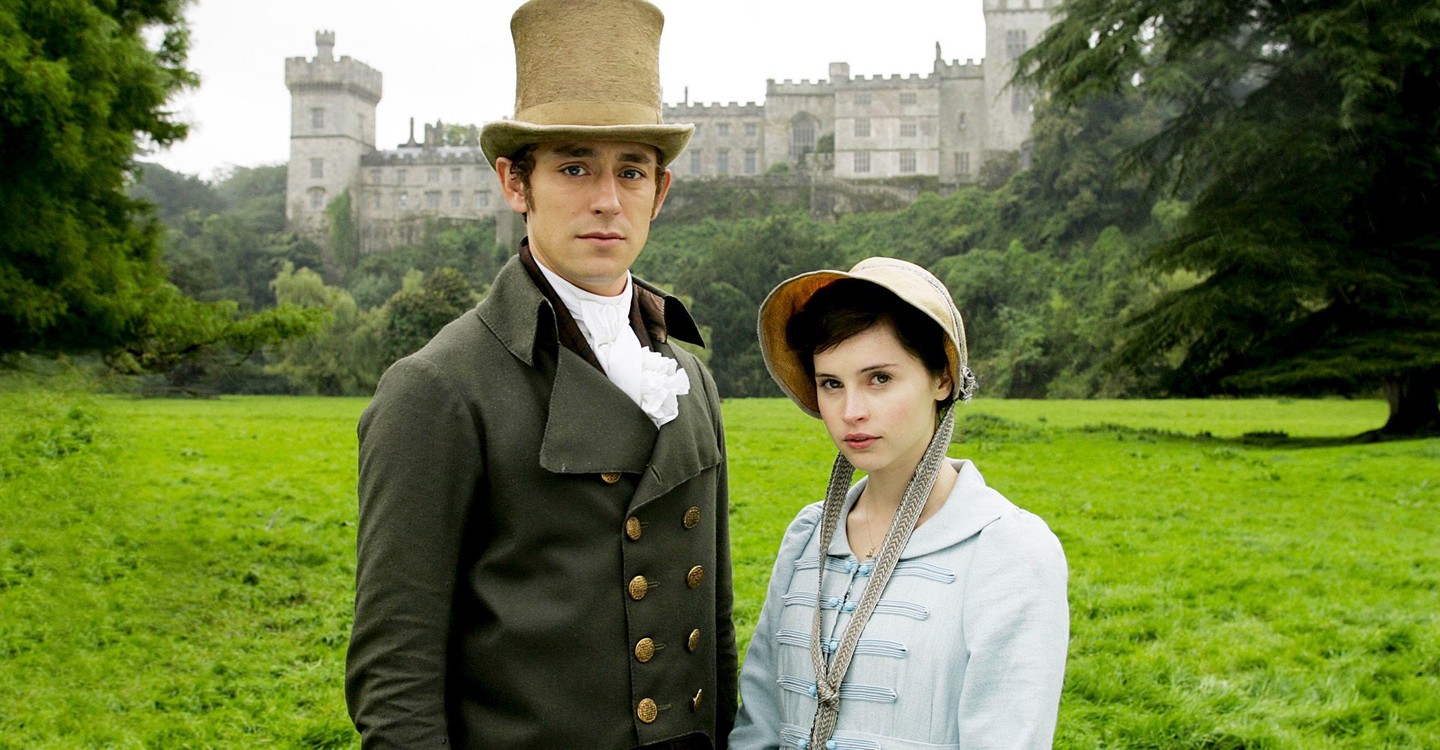
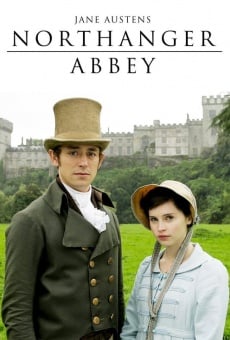
 PS – If you haven’t read Northanger Abbey lately or perhaps ever, I’d like to invite you to read/reread it now, so that you’ll be ready for its sequel when it comes out next month! – for that seamless transition the beta reader spoke of above. Think you won’t care for NA? Take another look with an open mind. Although in a different style from Mr. Darcy or Mr. Knightley, Henry Tilney is a worthy hero (
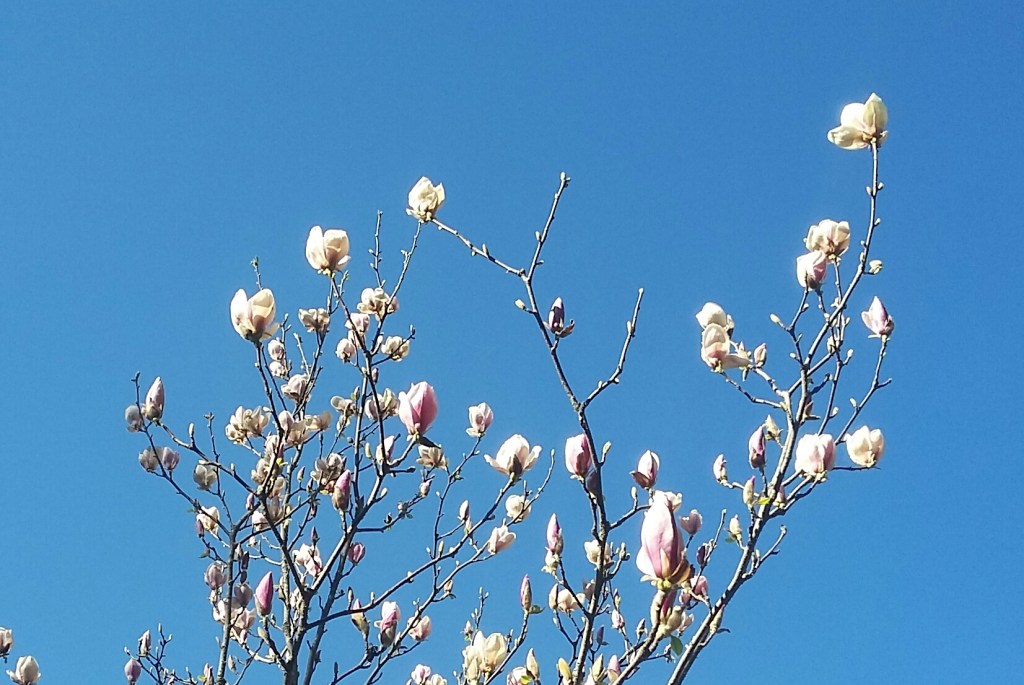 Yesterday was such a beautiful Spring day in the Pacific Northwest. The sky was blue, the birds were singing, the thermometer topped 70 degrees for the first time in a long while, and my magnolia tree burst into glorious bloom. At my house in the country, surrounded by all that “rightness,” it was hard to believe anything could be very wrong in the world. Yet I knew that when I turned on the TV, there would be a new, shockingly high COVID-19 death count. There would be more heart-wrenching stories of loved ones lost, incredible hardships, and financial devastation.
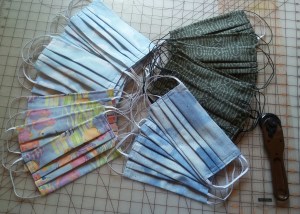 I’m trying to do what little I can. I’m obeying the ‘stay at home’ order to avoid adding to the problem. I’ve sewn and donated a few dozen masks and given some money. But I wish I could to do more to help. Unfortunately, I don’t have the training to save lives on the front lines. I’m not a scientist researching a cure. I’m not even a grocery worker or someone else providing an essential service. I’m a writer.
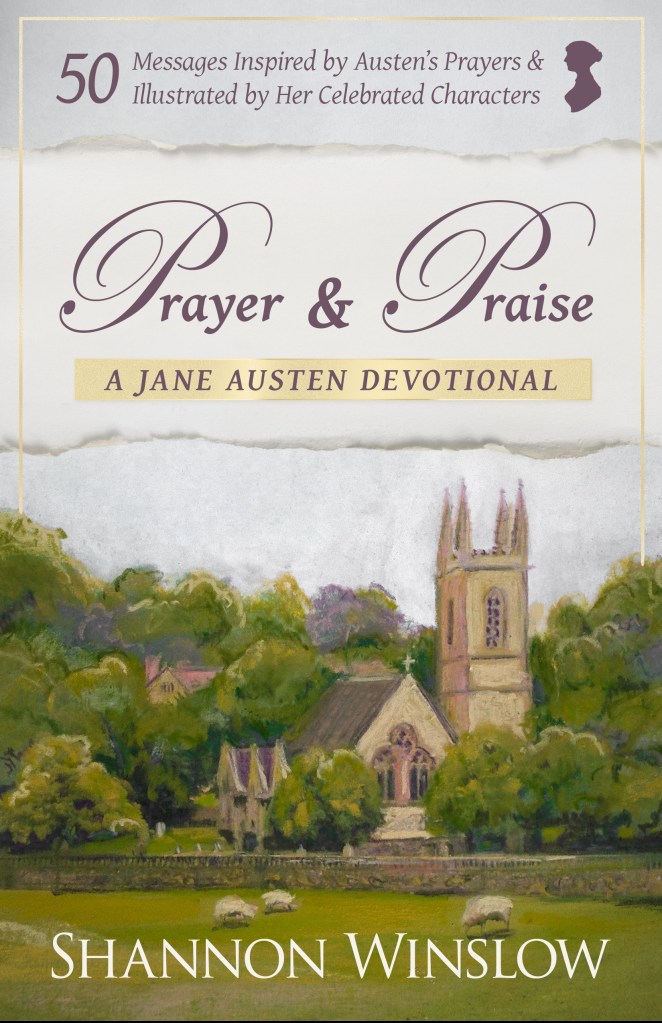 During the current crisis, I’m pleased to be basically giving it away to anybody who wants it – as close to free as I can make it, that is. For a limited time, it is available at
  Today is Good Friday, the day Christians commemorated Jesus Christ’s suffering and death on the cross. Despite the horror of the event, it’s appropriate to call it ‘
 I especially enjoy writing the many letters included in my novels, trying to make each one a little work of art, as Jane Austen did. (More on that topic
  Then yesterday, as I was forging ahead with the rewrites for my current
  I love movies and I love Jane Austen, so what could be better than a movie about Jane Austen?
![Pageflex Persona [document: PRS0000037_00034]](https://shannonwinslow.com/wp-content/uploads/2014/07/the-persuasion-of-miss-jane-austen-cover_proof_09.jpg?w=193) As most of you know, I have my own theory as to the source of Jane Austen’s knowledge of romance. Although in
As most of you know, I have my own theory as to the source of Jane Austen’s knowledge of romance. Although in  Let me start by wishing you all a wonderful 2020! Since all the hubbub of the holidays has at last died down, I’ve found time to get a little writing done again. I’m 200 pages into my Northanger Abbey sequel – Murder at Northanger Abbey (see
 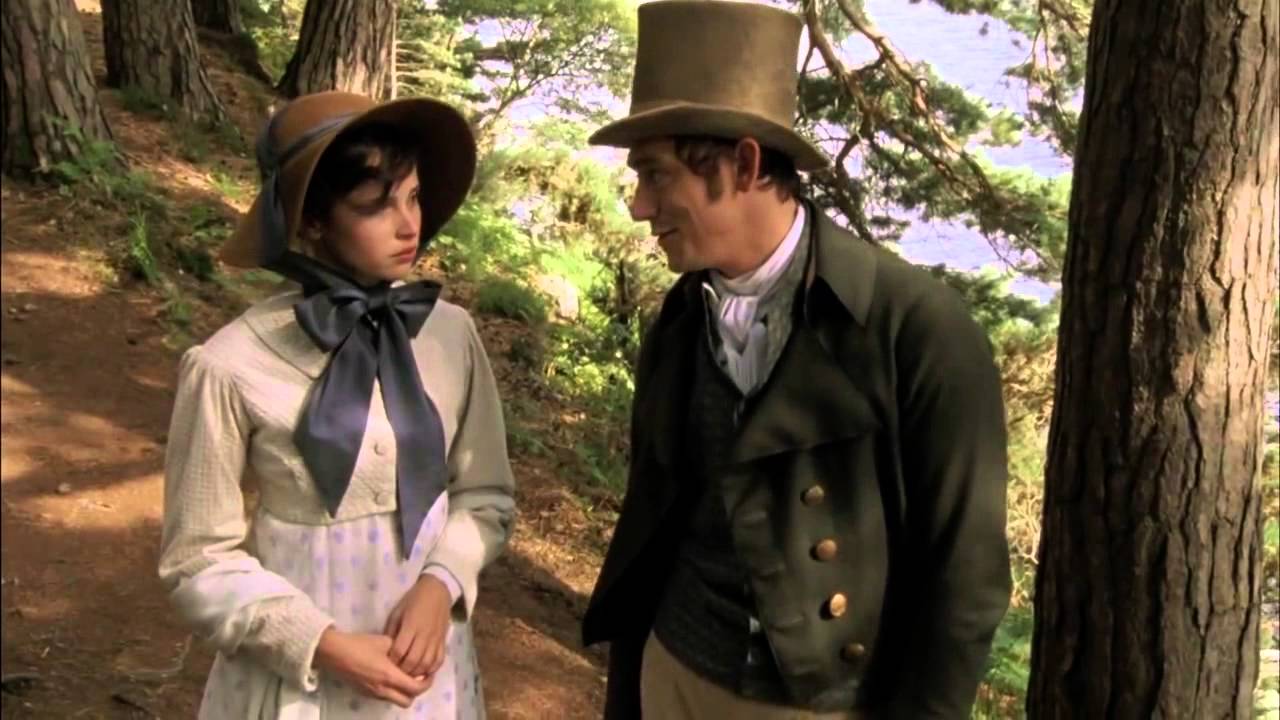 Is what Jane Austen says about the novel, here and in chapter 5 (the greatest powers of the mind displayed, thorough knowledge of human nature, lively effusions of wit, best-chosen language) her way of tooting her own horn? Sure, but it’s probably her honest opinion as well. She and her family were enthusiastic novel readers, and, according to one of her preserved letters, “not ashamed of being so.”
 Several years ago, because of the above reference in
 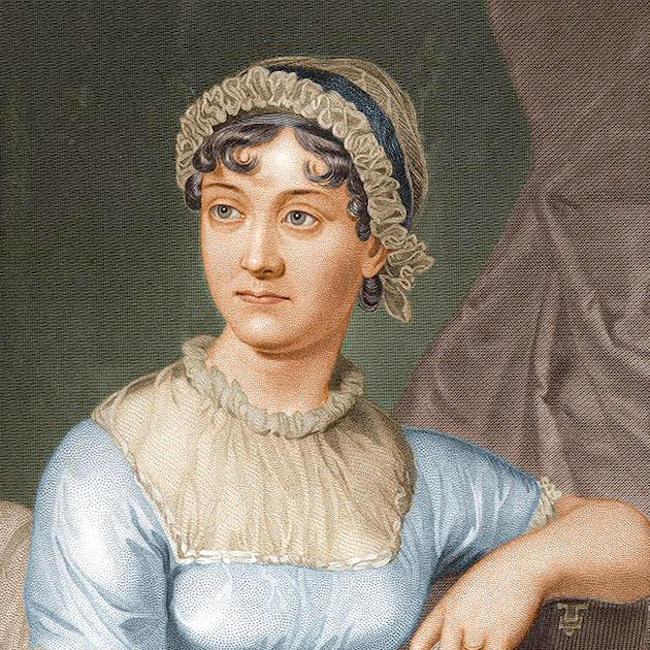 Nowadays, we have a lot to choose from, dozens of different mediums competing for our entertainment time and dollar. But I hope the novel never goes out of style (and not just because I write them). I’m sure Jane Austen would agree with me. In fact, I think I can hear her now, giving us a piece of her mind.
 Who is that behind that mild mannered dental hygienist exterior? Could it be a superhero?
  Winslow: Yes, they’re still around but, sorry, not much blackmail potential left. The first novel I wrote (The Darcys of Pemberley) was published in 2011. So it’s already out there for the whole world to see.
 Winslow: When I find myself in between missions, I like to hole up at a deluxe log cabin deep in the country where I have a special room I euphemistically call “my studio” (translation: my eldest son’s bedroom, which I appropriated for my own use the day he left for college). There, surrounded by books and art supplies of every description, stacked an average of 18” high, I am literally immersed in creative clutter. I hide from the world (or at least from housework), I recharge my batteries, and I plot my next move.
 Winslow: Holding the first physical copy of my first published novel is pretty close to the top of my list. I also love doing book club appearances, and I had a great time at the JASNA AGM last fall. But I think the best moments have come via hearing directly from readers who have taken the time to let me know how much they liked one of my books. That never gets old. It’s always amazing to learn that something I’ve created has given hours of enjoyment to a total stranger. And now that person isn’t at total stranger anymore, but someone connected to me by a shared experience.
 I also want to take this chance to wish you all a very Merry Christmas and blessings on you and your family, however you celebrate the holiday season! Since this wasn’t a particularly Christmassy themed post, I want to invite you to visit a few previous posts that are:
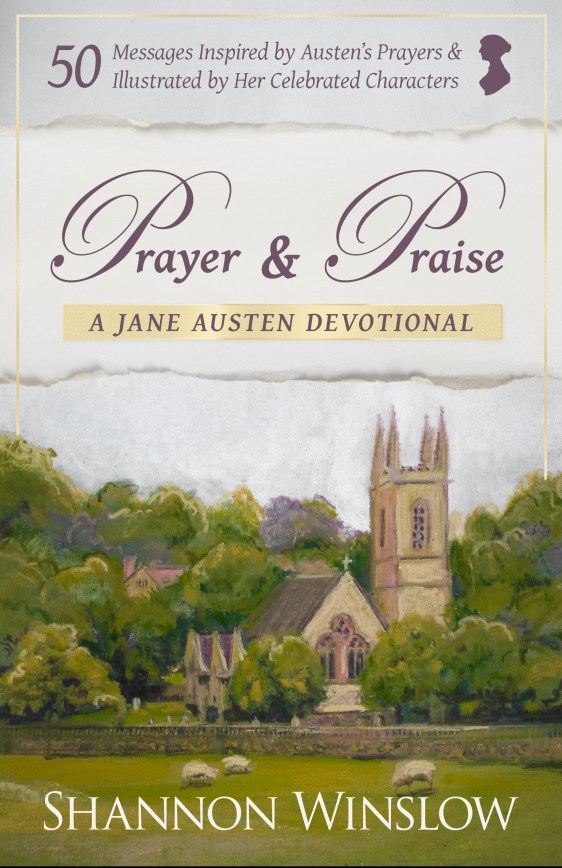 Woohoo! It’s book launch day for Prayer and Praise: A Jane Austen Devotional!
 Join me as I weave together my passion for writing and my love of all things Jane Austen. Please also look for me on Facebook.




 Shannon Winslow's "Jane Austen Says..."