Any Other Place

“Such a fortnight as it has been!” he continued; “every day more precious and delightful than the day before! – every day making me less fit to bear any other place. Happy those, who can remain at Highbury!” (Frank Churchill, Emma, chapter 30)

Along with compelling characters, a good writer also delivers an engaging setting. It grounds the story by planting its people and events in a specific time and place. It gives the reader a world to escape to and explore. Tara, Pemberley, Mitford, even the Planet of the Apes: these names evoke strong images. We experienced them first through the pages of books.

Setting doesn’t require exhaustive, flowery descriptions of landscape, architecture, and furnishings. Preferably not. Jane Austen never resorted to that technique. She gave us just enough information to set our imaginations off in the right direction. The rest unfolded primarily through the kind of people who inhabited her houses and villages, the way they behaved (or misbehaved), and how they felt about where they lived and visited. For example…

It was a handsome, stone building, standing well on rising ground and backed by a ridge of high woody hills … Elizabeth was delighted. She had never seen a place for which nature had done more, or where natural beauty had been so little counteracted by an awkward taste … The rooms were lofty and handsome, and their furniture suitable to the fortune of their proprietor; but Elizabeth saw, with admiration of his taste, that it was neither gaudy nor uselessly fine …

Our opinion of Pemberley is influenced more by Elizabeth’s impressions and the high regard the housekeeper, Mrs. Reynolds, has for her position and her employer than by direct description of what the place looks like. The same is true for Highbury in Emma. I don’t recall any of the specific facts Austen surely gives us about the town, only that everyone (even a recent arrival like Frank Churchill) speaks of the village with affection.

How magical, then, to create fictitious worlds of our own! As writers, we fashion them brick by brick, laboring until we can taste the dust of the streets, smell the pile of horse manure we sidestep, and exchange greetings with the other inhabitants – our good friends – as they go about their business. We come to delight in our daily sojourns there … perhaps a little too much. The downside? The deeper we immerse ourselves in a beloved book (as readers, and especially as writers) the more attached we become to the neighborhood. Perhaps, as Frank says, this makes us less and less fit to bear any other place … such as the real world.

Posted in Jane Austen, writing | Tagged , , , , , , , | Leave a comment

Close Relations

>

“I do not mean to say that a woman may not be settled too near her family. The far and near must be relative, and depend on many varying circumstances. Where there is fortune to make the expense of travelling unimportant, distance becomes no evil.” (Pride and Prejudice, chapter 32)
Elizabeth says this to Mr. Darcy after he implies that fifty miles distant is a very agreeable place to keep one’s family. No doubt, he was already thinking of carrying Lizzy off to Pemberley (shown above is Hampton Court Palace, the closest thing I have to Pemberley) and away from her most uncouth relations. I echoed the sentiment in The Darcys of Pemberley when Jane and Mr. Bingley announce their intentions to move away from Hertfordshire: Although he did not say the words, his meaning was clear enough. They could all appreciate the idea that it is possible for a woman to be settled too near her family. This was to fulfill what Jane Austen tells us in the last chapter about their future:
 
Mr. Bingley and Jane remained at Netherfield only a twelvemonth. So near a vicinity to her mother and Meryton relations was not desirable even to his easy temper and her affectionate heart. The darling wish of his sisters was then gratified; he bought an estate in a neighboring county to Derbyshire, and Jane and Elizabeth, in addition to every other source of happiness, were withing thirty miles of each other.
I concur with Elizabeth’s statement above. It depends entirely on the circumstances. Had I a mother like hers, fifty miles would be a bare minimum. I am more fortunate, though. I have always enjoyed the support of close family, especially when I was a clueless young mother. Now it is my turn to be there for ageing parents and busy adult children with children of their own. My husband and I have talked about how wonderful it would be to retire to someplace with endless sunshine, surf, and sandy beaches. But, since we don’t have a “fortune” to constantly travel back and forth whenever mood or need arises, the distance for us would be an evil impossible to overcome. Elizabeth had no such limitations. She ended living in a bit of paradise with her favorite sister close by and means to travel at will. The best of both worlds.
Posted in England, Jane Austen, my books | Tagged , , , , , , , , , | Leave a comment

Older But Wiser

Marianne Dashwood was born to an extraordinary fate. She was born to discover the falsehood of her own opinions, and to counteract, by her conduct, her most favourite maxims. She was born to overcome an affection formed so late in life as at seventeen, and … voluntarily to give her hand to another! … But so it was. Instead of falling a sacrifice to an irresistible passion, as once she had fondly flattered herself with expecting … she found herself at nineteen, submitting to new attachments, entering on new duties, placed in a new home, a wife, the mistress of a family, and the patroness of a village … Marianne could never love by halves; and her whole heart became, in time, as much devoted to her husband as it had once been to Willoughby. (Sense and Sensibility, chapter 50)

I love this insightful account of the revolution in Marianne’s character throughout the course of the story. In the beginning, she is ruled by her feelings alone. Without a single scruple she throws caution (and propriety) to the wind … and herself into Willoughby’s arms, taking her romantic sensibilities so far that she cannot imagine going on without him. By the end, she has, through painful experience, gained a more balanced perspective and a measure of common sense. She’s learned that her sister’s more conservative approach to life may have some merit after all. She also ultimately discovers it is possible to love again, and that the second, though different, may be just as satisfying (and far more enduring) than the first.

I’ve always identified more like Elinor – sensible, steady, doing what’s right. But, if I look back to my early teens, I realize I may have started out much more like Marianne than I care to admit – overly romantic (something I probably haven’t completely outgrow, to tell the truth) and prone to melodrama. After all, Romeo and Juliet was my first movie obsession (and Leonard Whiting my first crush – anyone else with me?) Like Marianne, I wallowed in the misery of my first heartbreak for months. Fortunately, I too lived to love again.

So, who is your role model -Elinor or Marianne? And would you choose the dashing Willoughby or Col. Brandon, “the very best of men”? Tough decision, probably because we tend to want it all. We’d like to think we are both smart and emotionally deep; and our ideal man would embody all the best of both Willoughby and Brandon.

Posted in Jane Austen, life | Tagged , , , , , , , | Leave a comment

Good Company

“My idea of good company, Mr. Elliot, is the company of clever, well-informed people, who have a great deal of conversation; that is what I call good company.” “You are mistaken … that is not good company; that is the best. Good company requires only birth, education and manners, and with regard to education is not very nice.” Persuasion, chapter 16

This conversation takes place between Anne Elliot and her cousin Mr. Elliot as a result of Anne’s disgust over the extreme deference shown to Lady Dalrymple (a viscountess) and her daughter. We are told that the women in question possess no superiority of manner, accomplishment, or understanding deserving special attention, and that their presence would be barely tolerated (let alone their favor curried) but for their rank.

In theory at least, most of us would probably agree with Anne that a person’s value should be based on something more substantial than an accident of birth. In the US, we may pride ourselves on our supposedly “class-free” society, feel superior for our democratic constitution which states that “all men are created equal” (even though, when those words were penned, “all” didn’t include women or minority races). And, of course, the system of government in the UK has evolved in the past two hundred years as well. Power is no longer exclusively in the purview of white, male land-owners.

Yet, have you noticed that if we don’t have a system of aristocracy already in place, we tend to create one? We elevate people to celebrity status (movie, TV, music, and sports stars, along with other rich and famous), we pay them outrageous sums of money, and then treat them with the same special deference Lady Dalrymple enjoyed. Celebrity watching (our American version of royal watching) has achieved cult status. If you don’t believe me, check “the news” on your Internet home page. I bet you’ll find it’s at least two-thirds gossip about what star is dating what other star, who’s showing off her bikini bod or baby bump, and how some mighty person has fallen from grace.

I’m reminded of a line in the prologue to my novel The Darcys of Pemberley. Considering that the Bennets, as the most prominent family in the area, were celebrities of sorts, it fits: Developments in the Bennet family and amongst their connections always provide a fertile source of conversation for those in the neighborhood whose own lives hold little excitement and few distinctions to celebrate.

We say we believe in equality, but we don’t always behave that way. I guess that means we’re a bit hypocritical, Jane Austen (my favorite celebrity) included. Her stories rail against the unfair plight of her heroines – usually well-bred young women discriminated against for their lack of fortune – as if rank and financial status shouldn’t matter. Yet she sheds no tears for the servants who make the gentry’s lifestyle possible, and sees to it that most of her heroines marry rich men! Not a criticism; just an observation. In truth, I don’t want to read (or write) stories about true poverty and misery. There’s plenty of that in real life. I’ll admit it; I, like Jane Austen, prefer the a fairy tale ending.

Posted in Jane Austen, my books | Tagged , , , , , , | Leave a comment

The Indignities of a Heat Wave

What dreadful hot weather we have! It keeps one in a continual state of inelegance.

So wrote Jane Austen in a letter – a bit of simple wisdom as true now as it was when she set it down on paper two hundred years ago. On second thought, perhaps it was truer then since baths were few and far between. No running water, hot or cold. Every gallon needed for a bath had to be heated on the kitchen stove and hauled up two flights of stairs. Afterward, one couldn’t simply pull the plug and let the tub drain either. Presumably, the water had to be scooped out and hauled back down (or maybe they bailed it out the window!).

When I found the quote above, it reminded me of a line from my first novel – the sequel to Pride and Prejudice titled The Darcys of Pemberley. Add the barnyard smell of hundreds of horses and other animals to thousands of overly fragrant people, pack them all close together, and turn up the heat. That was London in the dog days of summer. I suppose the sewage ran straight into the Thames too. Sounds lovely, doesn’t it?

The simmering heat only served to intensify the more unpleasant aspects of living in close quarters with so much humanity and horseflesh. If one dared open the windows in hopes of some relief from the stifling air indoors, one quickly closed them again against the noise and odors emanating from the streets. For those who had the option of somewhere else to go, the advent of such conditions began turning thoughts toward getting out of town …

For this reason, among others, I would have preferred retreating to the quiet and fresh air of the country, as did the Darcys. But then, if you owned the finest estate in Derbyshire, why would you want to be anywhere else?

Posted in Jane Austen, my books | Tagged , , , , , , | Leave a comment

The Pleasure of a Good Novel

“The person … who has not pleasure in a good novel must be intolerably stupid. I have read Mrs. Radcliffe’s works, and most of them with great pleasure. The Mysteries of Udolpho, when I had once begun it, I could not lay down again. I remember finishing it in two days, my hair standing on end the whole time.” (Henry Tilney, Northanger Abbey)

Is this Jane Austen’s way of tooting her own horn? Sure, but it’s probably her honest opinion as well. She and her family were enthusiastic novel readers, and, according to one of her preserved letters, “not ashamed of being so.” The idea of being ashamed to admit reading novels sounds absurd. In Austen’s day, however, when that literary form was in it’s infancy, the novel did not yet enjoy wide social acceptance. Plays and poetry were considered more the thing. Shakespeare, probably the most revered English author of all time, never wrote a novel, after all.

Because of the above reference in Northanger Abbey, I became curious about The Mysteries of Udolpho. It’s a real book, one Jane Austen read. Much to my surprise, I discovered it available through my local public library. I checked it out and read it. It took me at least a couple weeks (not two days like Henry Tilney), and I didn’t feel my hair standing on end even once, which was a disappointment. Tame by today’s standards and painfully long-winded. Wordy. Isn’t it somehow ironic to accuse a book of having too many words? Yet it’s a common criticism of “the classics.” Even in Jane Austen, who was not as given to exhaustive descriptions as most, you can find enormously long paragraphs and speeches compared to the soundbites we’re used to now.

That older style isn’t inferior; it was appropriate for the time. When books were one of the few sources of entertainment, I imagine readers wanted their treasured novel to last as long as possible. Precise, detailed descriptions were a plus for anyone not able to easily visualize other times, places, and social strata by simply turning on a television. Add the fact that writers (Dickens, for instance, with his serialized works) were sometimes paid by the word and the phenomenon is explained.

Nowadays, we have a lot to choose from, dozens of different mediums competing for our entertainment time and dollar. But I hope the novel never goes out of style (and not just because I write them). Come on, people! Turn off your digital devices and pick up something that’s stood the test of time: a good, honest read. Be reminded how reassuring the weight of a book feels in your hand, how satisfying it is to turn the pages one by one. Don’t be “intolerably stupid.” Read a novel!

Posted in Jane Austen, writing | Tagged , , , , , , | Leave a comment

Rational Creatures

“I hate to hear you talking so … as if women were all fine ladies instead of rational creatures.” (Mrs. Croft to her brother, Frederick Wentworth, in chapter 8 of Persuasion)

Although Jane Austen may not seem progressive to a modern audience, certain aspects of her stories would have been considered downright revolutionary in her day. Nothing more so than her depiction of women as “rational creatures.” Not that she didn’t also write female characters who little deserved the title. But, by and large, the women who inspired the love of her heroes and earned the devotion of her readers (then and now) are those who were well read, intelligent, and possessed a good deal of common sense.

What’s revolutionary about that? In Jane Austen’s day, women were not only non-persons legally and socially (except as extensions of their fathers or husbands), they were generally considered vastly inferior creatures unworthy of higher education and incapable of higher thought. So, to call a woman rational was a clear contradiction in terms. To insist that she had the same capacity for reason as a man was a strongly feminist and highly controversial stand.

Jane Austen was no political activist. She didn’t protest in front of the Parliament building or burn her corset in the town square. Her novels rarely even alluded to world events or governmental affairs. She instead made her case for recognizing the rationality of women with subtle strokes of her pen. Her strong female characters and her respected body of work speak volumes for her.

Posted in Jane Austen | Tagged , , , , | Leave a comment

Polluted Shades

“Heaven and earth! – of what are you thinking? Are the shades of Pelmberley to be thus polluted?”

Did you know that pollution is not a problem exclusively of the modern era? Lady Catherine de Bourgh, as you see from her statement above (Pride and Prejudice, chapter 56), was concerned about its noxious effects even in the early 1800s, when she “lived.” Of course the pollution she railed against was the contamination of noble realms by unworthy personages such as Elizabeth Bennet’s low connections. In her eyes, the shortest visit of one of these at Pemberley would have left a stain on its woods that no amount of time could ever erase.

Lady Catherine is one of those delightful villains that we love so much to hate. She’s also a writer’s dream. Just like actors often report that wicked characters are more fun to play than the nice ones, villains are often more enjoyable to write for too. Even though I avoid confrontation in real life, I love to write that kind of scene. Think about the contest of wits between Lizzy and her ladyship that included the line quoted above. Lady Catherine creates conflict and confrontation wherever she goes, so I was thrilled to give her a prominent role in the Darcys of Pemberley, my sequel to Pride and Prejudice. I began with Jane Austen’s final chapter as my jumping-off point, studying it carefully for clues to what she saw in her characters’ futures and carefully respecting those ideas. This is what we learn there about Lady Catherine:

Lady Catherine was extremely indignant on the marriage of her nephew; and as she gave way to all the genuine frankness of her character, in her reply to the letter which announced its arrangement, she sent him language so very abusive, especially of Elizabeth, that for some time all intercourse was at an end. But at length, by Elizabeth’s persuasion, he was prevailed on to overlook the offence, and seek a reconciliation; and, after a little farther resistance on the part of his aunt, her resentment gave way, either to her affection for him, or her curiosity to see how his wife conducted herself; and she condescended to wait on them at Pemberley, in spite of that pollution which its woods had received …

I used Jane Austen’s own words as the guide for all the characters, contradicting nothing she wrote in her epilogue. She left me plenty of good material to work with while not boxing me in too tight. So, I made the most of Lady Catherine’s nasty disposition and aristocratic snobbery before finally humbling her into accepting the new mistress of Pemberley:

News soon spread throughout the neighborhood that there would be nobility coming amongst them, and the watch began for a very fine closed carriage – a barouche with coat of arms it was rumored to be – which would convey Lady Catherine de Bourgh to Pemberley. When the great lady was assured that the place was free of riffraff, she did come, bringing her daughter and son-in-law with her for the event. Her previous visit having been long before the current Mrs. Darcy presided, she keenly anticipated finding a serious decline in the dignity and polish of the grand estate under the new management. However, though she scrutinized the house and grounds down to the minutest detail, all her efforts were frustrated; Pemberley was just as fine as it had ever been when her own sister was its mistress.

I can well imagine how much Jane Austen enjoyed giving Lady Catherine a good set down (by way of Elizabeth’s mouth), for I took equal pleasure making sure she got her comeuppance in my story.

Posted in Jane Austen, my books, writing | Tagged , , , , , , , , , | Leave a comment

The Pump-room

>

Every morning now brought its regular duties – shops were to be visited; some new part of the town to be looked at; and the Pump-room to be attended, where they paraded up and down for an hour, looking at everybody and speaking to no one.
 
This passage describes Catherine Morland’s early days in Bath (chapter 3 of Northanger Abbey). She was on a grand adventure, leaving her quiet village to sample the delights of a fashionable spa town as the particular guest of the Morlands’ wealthy neighbors, the Allens. The only flaw in the pleasure scheme was their lack of acquaintance in Bath. Mrs. Allen, as you may recall, continually bemoans that circumstance. It was no trivial complaint either, since one couldn’t talk to (let alone dance with) a person until one had been properly introduced. Hence, the above comment about looking at everybody and speaking to no one.
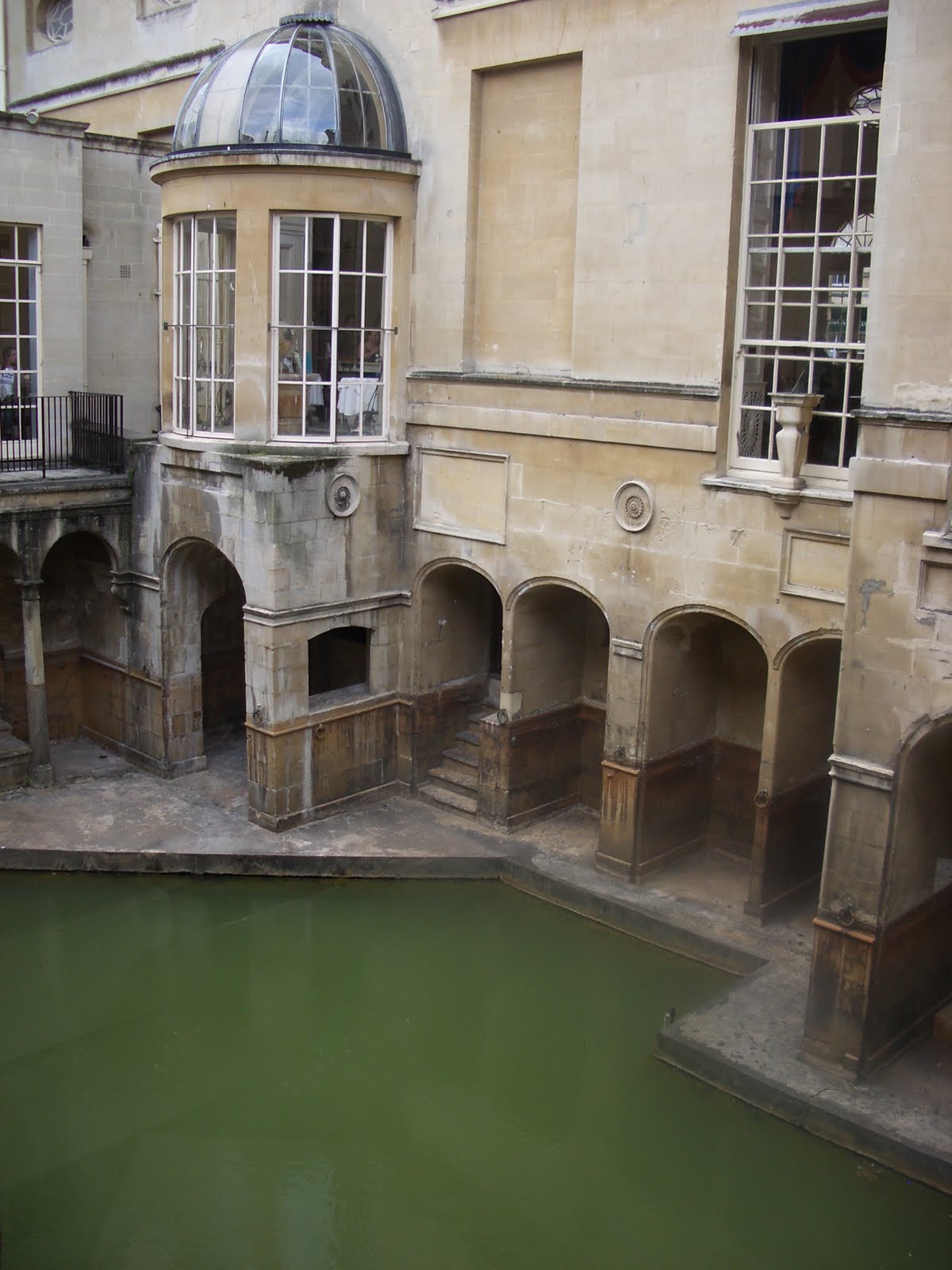
Because of its place in both Jane Austen’s writings (Northanger Abbey and Persuasion) and in her real life (having lived there herself for a time), I couldn’t wait to go to Bath when I was in England two years ago. Although my visit was all too brief, I took in as much as I could, particularly wanting to see locations mentioned in her two books and to get a feel for the town, since I was setting my own novel (For Myself Alone) partially there. The Pump-room features prominently in both. At the heart of the community, it was the place to see and been seen, and to discover who else was currently in residence. Whether one was in town for health or holiday, the Pump-room had to be attended.
In For Myself Alone, my heroine, Josephine Walker, gives her impressions of the Pump-room:
 
Crowds of fashionable people pass daily through its portals seeking the healing waters and the company of their peers. Reputedly, so many valuable acquaintances are renewed and favorable alliances formed within its hallowed walls that each visit holds as much promise for social as medicinal advantage. Thus, with high expectations, we joined the throng of pilgrims drawn to the Pump-room. As Papa bathed in the warm, spring-fed pool below, Mama and I filled our time by parading up and down the main room in concert with all the others similarly left with no more-useful employment. The scale of the place gave even this ordinary exercise a feeling of grandeur.
 
Other than the fact that it’s now set up for serving high tea, the room has not changed much since Jane Austen trod the floors two hundred years ago. It was a thrill to walk the same polished hard woods and sample the same foul-smelling water water from the King’s Fountain as she did then. So remember, if you get to Bath, you simply must attend the Pump-room too.
 
Posted in Bath, England, Jane Austen, my books | Tagged , , , , , , , | Leave a comment

A Charming Rake

“The gentleman offered his services, and perceiving that her modesty declined what her situation rendered necessary, took her up in his arms without further delay and carried her down the hill.”

Willoughby, oh Willoughby. Such a dashing rake. No wonder Marianne falls for him in Sense and Sensibility. First, he comes to her rescue when she twists her ankle. Next, he is discovered to be graceful, uncommonly handsome, and well-spoken. In the eyes of his female admirers, Sir John’s assessment of him (a decent shot, a bold rider, possessing a fine pointer as well as very pretty property) does nothing to detract from his other charms. The added intelligence that Mr. W is a tireless dancer, a talented musician, and an enthusiastic reader seals the deal. He is exactly the sort of gentleman capable of attaching Marianne’s affections … and he does so effortlessly.

In the early chapters, the reader’s only hint that Willoughby may not be so perfect after all is his open contempt for Colonel Brandon. “Brandon is just the kind of man … whom everybody speaks well of, and nobody cares about; whom all are delighted to see, and nobody remembers to talk to.” His words serve as no warning for Marianne, however, since she feels the same way – a clue to her own shortcomings. Of Brandon she declares, “… he has neither genius, taste, nor spirit.” Elinor objects to their cooperative character assassination, and Willoughby offers the following explanation:

“I have three unanswerable reasons for disliking Colonel Brandon: he has threatened me with rain when I wanted it to be fine; he has found fault with the hanging of my curricle; and I cannot persuade him to buy my brown mare. If it will be any satisfaction to you, however, to be told that I believe his character to be in other respects irreproachable, I am ready to confess it. And in return for an acknowledgment, which must give me some pain, you cannot deny me the privilege of disliking him as much as ever.”

Well, at least he has good reasons for his prejudice. Thinking of the ’95 acclaimed production, where Greg Wise whirls Kate Winslet around as he delivers a close approximation of this speech, I daresay I would have been convinced as well. I liked the above quote so much, in fact, that I included a portion of it in my second book, For Myself Alone – one of the many Jane Austen lines I managed to slip into the text. This time, it’s a father disparaging the worth of his potential son-in-law:

“Upon my honor, Josephine, I had hoped to see you do better for yourself as to fortune. A man of some little property would have suited my ambitions very well. Mr. Arthur Evensong may prove a great success in the end, but as of this moment I have seen very little evidence of his genius. If it will be any satisfaction to you, however, to be told that I believe his character to be in other respects irreproachable, I am ready to confess it …”

We can’t always explain our gut-level dislike for someone, but we would fight to defend our right to our opinion, however irrational. In Willoughby’s case, though, his instinctive antagonism toward the colonel is not totally misplaced, just premature, since the worthier Brandon gets the lady they both love in the end.

Posted in Jane Austen, my books, Shannon Winslow's writing | Tagged , , , , , , , | Leave a comment