By the Sea

 I spent the weekend at a small writer’s conference that was held on the Washington State coast, near Longbeach.  As you can see, the weather was beautiful – something we don’t take for granted here, especially in March. 

Saturday’s schedule was packed so full that I had to content myself with the view from the conference center.  But yesterday, before breakfast, a friend and I hiked down to the water to take it all in at closer range: the sea, the sand, the waves, the flat shoreline stretching for miles in both directions.  The sun was out, and, with no wind to steal away its heat, the delicious warmth sank through my clothing and deep into my soul.  Glorious!

I felt like I was reenacting Anne and Henrietta’s walk on the beach at Lyme, quoted here from Jane Austen’s Persuasion (chapter 12).

Anne and Henrietta, finding themselves the earliest of the party the next morning, agreed to stroll down to the sea before breakfast.  They went to the sands, to watch the flowing of the tide, which a fine south-easterly breeze was bringing in with all the grandeur which so flat a shore admitted.  They praised the morning; gloried in the sea; sympathized in the delight of the fresh-feeling breeze and were silent …    (Persuasion, chapter 12)

Henrietta goes on to extol the beneficial effects of sea air, particularly for an ailing constitution.  Whether it was the ocean air or the company of my fellow writers (both, I presume) the weekend by the sea did me a world of good.

Posted in Jane Austen, Jane Austen Quotes, travel, writing | Tagged , , , , , , , | 1 Comment

Show and Tell

I’m teaching a class this weekend at a small writers’ conference.  The topic of my little one-hour workshop is “Show, Don’t Tell.”  I doubt Jane Austen ever worried about it, but most modern writers have heard this criticism enough to hate the mention of it.  For benefit of the uninitiated, it means learning to convey crucial information about character and emotion without coming right out and telling the reader in so many words.  Instead of “telling” the fact that Tom is cruel and unfeeling, for instance, we “show” him kicking a dog and stealing candy from children.  Simplistic example, but you get the idea. 

So, for my Jane Austen quote, I searched high and low for something with the words show and/or tell.  Here’s what I found:

“You will not ask me what is the point of envy.  –  You are determined, I see to have no curiosity.  –  You are wise  –  but I cannot be wise.  Emma, I must tell what you will not ask, though I may wish it unsaid the next moment.”    (Emma, chapter 49).

Here, Mr. Knightley is about to “tell” Emma that he’s in love with her.  If only he’d attended my class first!  Then he would have known that he’d get his point across more effectively by “showing” Emma how he feels instead.  To quote from my lecture notes: Use “showing” whenever you want to make a deep impression, when you want the reader to notice, feel, or infer something.  If you substitute “Emma” for “reader”, the advice fits pretty well.  Mr. Knightley certainly wanted to make a strong, favorable impression on Emma.  He hoped she would notice what a great catch he was,  feel something for him in return, and infer that marriage to the handsome owner of Donwell Abbey would be the most pleasant thing imaginable. 

Despite violating this tested literary principle, Mr. Knightley did eventually succeed in communicating his affection and was then assured that Emma reciprocated.  But think of all the intervening grief (Emma paining him by refusing to listen, then calling him her “friend”) he would have been spared had he simply kissed her.  I think she would have drawn the right conclusions – no “telling” required.

Posted in Jane Austen, Jane Austen Quotes, writing | Tagged , , , , , , , | Leave a comment

Celebrating!

She was looked at however, and with some admiration; for, in her own hearing, two gentlemen pronounced her to be a pretty girl.  Such words had their due effect; she immediately thought the evening pleasanter than she had found it before – her humble vanity was contented – she felt more obliged to the two young men for this simple praise than a true quality heroine would have been for fifteen sonnets in celebration of her charms, and went to her chair in good humour with every body, and perfectly satisfied with her share of public attention.  (Northanger Abbey, chapter 2)

Such were Catherine Morland’s gratified feelings after her first, and mostly unsuccessful, ball at Bath.  As you recall, she’d not been able to dance because of having no acquaintance in town (a fact Mrs. Allen bemoaned again and again).  Yet, Catherine had been admired, and that, for the moment, was enough to satisfy her.  Jane Austen understood human nature well; she knew that a simple word of praise goes a long way.  It can quench the thirst for approval and give encouragement to carry on. 

I can relate to Catherine.  I’m sometimes discouraged by how slowly my writing career is progressing.  I work hard and seem to be getting close to a breakthrough, only to be disappointed again.  But a small morsel of praise now and then goes a long way.  Suddenly, the day looks brighter and my humble vanity is contented.

Consequently, today I am in good humour with everybody and perfectly satisfied with my share of public attention.  Why?  Because my short story (Mr. Collins’s Last Supper) made it into the finals of the Jane Austen Made Me Do It short story contest!  Woo-hoo!  It may not ultimately win, but for now this small victory is enough to keep me going.  

I suppose I shouldn’t need anyone to validate my work.  And, according to Jane’s words above, being satisfied with less than fifteen sonnets celebrating my charms means I’m not a “true quality heroine.”  I’m okay with that.  I’m just grateful people took the time to read my story, appreciate it, and vote me into the finals.  Thank you one and all!  I’m very much obliged.

Posted in Bath, Jane Austen, Jane Austen Quotes, Shannon Winslow's writing, writing | Tagged , , , , , , , | 2 Comments

Make Haste!

John Thorpe was soon with them, and his voice was with them yet sooner, for on the stairs he was calling out to Miss Morland to be quick.  “Make haste!  Make haste!” as he threw open the door – “Put on your hat this moment – there is no time to be lost – we are going to Bristol.”  (Northanger Abbey, chapter 11) 

The analogy is imperfect (and John Thorpe is not one of our favorite characters), but I couldn’t resist using this quote.  The image of calling you to don your bonnet and dash out the door was too charming.  In truth, this is simply a reminder that the two short story contests I’ve entered are closing at the end of the month.  So, if you wish to find out about “Mr. Collins’s Last Supper,” you must hasten  to the Republic of Pemberley ( www.pemberley.com), and thence to the place where silly stories known as Bad Austen dwell (http://badausten.com) to make the acquaintance of the “Woman of Wonder” and to hear the surprising tale of how “Miss Dashwood Gets Down and Dirty.”   But be quick; there’s not a moment to lose!

Posted in Uncategorized | Tagged , , , , , , , , | 1 Comment

Flight of Fancy?

“But now suppose as much as you chuse; give a loose to your fancy, indulge your imagination in every possible flight which the subject will afford …”  (Pride and Prejudice, chapter 60)

I’ve taken Lizzy’s advice and indulged my imagination by entering another Austen-related writing contest … of a slightly different sort.  This time it’s “Bad Austen” (http://badausten.com/) where entrants are invited to parody her style in whatever outrageous way they like, taking Austen places she’s never gone before.  Not that my submissions (“Miss Dashwood Gets Down and Dirty” and “Woman of Wonder”) are that outrageous.

Some may say it’s disrespectful to take such liberties with her canonical work.  But I think Jane would have approved.  Her own slightly irreverent sense of humor (which peeks out here and there in her novels and more so in her letters) is one reason we enjoy her writing so much.  I suspect that, if she’d thought she could get away with it, she might have been tempted to throw in the occasional zombie, super hero, or mud wrestling scene too.

Posted in Jane Austen, writing | Tagged , , , , , , , | Leave a comment

Mr. Collins’s Demise

Mrs. Bennet was really in a most pitiable state. …  The sight of Miss Lucas was odious to her.  As her successor in that house, she regarded her with jealous abhorrence.  Whenever Charlotte came to see them, she concluded her to be anticipating the hour of possession; and whenever she spoke in a low voice to Mr. Collins, was convinced that they were talking of the Longbourn estate, and resolving to turn herself and her daughters out of the house as soon as Mr. Bennet were dead.  Pride and Prejudice, chapter 23

I could not leave Mrs. Bennet in such a state!  I resolved at once to preserve her from the fate of seeing Charlotte Collins take her place as mistress of Longbourn.   I simply wrote a different outcome, one where Mr. Collins does not live long enough to inherit.  His untimely demise is the starting point for my first novel, The Darcys of Pemberley, and also the subject of a short story I recently wrote for the “Jane Austen Made Me Do It” Short Story Contest, currently underway.  If selected as the winner, it will be published by Random House in an anthology by the same name.  But don’t wait that long to find out what happens to Mr. Collins.  Go now (the contest ends Feb. 28) to www.pemberley.com (the Republic of Pemberley), look for the short story contest, and find #16 – Mr. Collins’s Last Supper by Shannon Winslow.  I would be honored if you take the time to read this little tongue-in-cheek tale, and more honored still if you choose to vote for it!

[Footnote: Mr. Collins’s Last Supper made it to the finals! See Short Stories page for updates.]

Posted in Uncategorized | Tagged , , , , , , , | 1 Comment

Truth Hurts!

“This is not pleasant to you, Emma – and it is very far from pleasant to me, but I must, I will, – I will tell you truths while I can, satisfied with proving myself your friend by very faithful counsel, and trusting that you will some time or other do me greater justice than you can do now.”  Emma, chapter 43

Badly done, Emma!  The quote above wraps up Mr. Knightley’s scorching reproof for her sharp witticism to Miss Bates at Box Hill.  Emma was blown back by his words, but immediately acknowledged the justice in them.  She was angry with herself, mortified, agitated, grieved, and vexed beyond expression.  In fact, the author tells us, Emma had never been so depressed.  Truth hurts! 

Reading over Emma’s disheartening list of emotions, I realized that’s close to how I feel when on the receiving end of a seemingly harsh critique of my work (“Badly done, Shannon!”).  I’m upset, embarrassed, depressed, ready to chuck it all.  My first instinct may be to kill the messenger for failing to recognize my genius.  But, eventually, I have to admit s/he might have a point or two.  Perhaps my perfect piece of prose is not so perfect after all – not yet, anyway.  Hard as it is to hear, though, I (like Emma) really need to hear it. 

A writer (or any other artist) can never be totally objective about his/her own work.  So how can you improve unless someone else shows you your flaws?  A good critique group will do this for you.  Your mother may swear everything you’ve written is pure gold (and her blind loyalty will help to buffer the acid in your stomach over the repeated rejections on the road to success), but we each need a couple of people who will tell it like it is – knowledgable, brutally-honest-yet-kind-hearted speakers of the plain truth.  By their faithful counsel, they prove themselves our friends, and they call us to do their confidence in us better justice in the future.  Hey, if Emma can benefit by a frank critique, there’s hope for the rest of us.

Posted in Jane Austen, writing | Tagged , , , , , | Leave a comment

Care to Take a Turn?

“I do not wish to avoid the walk. The distance is nothing when one has a motive; only three miles. I shall be back by dinner.” (Pride and Prejudice, chapter 7)

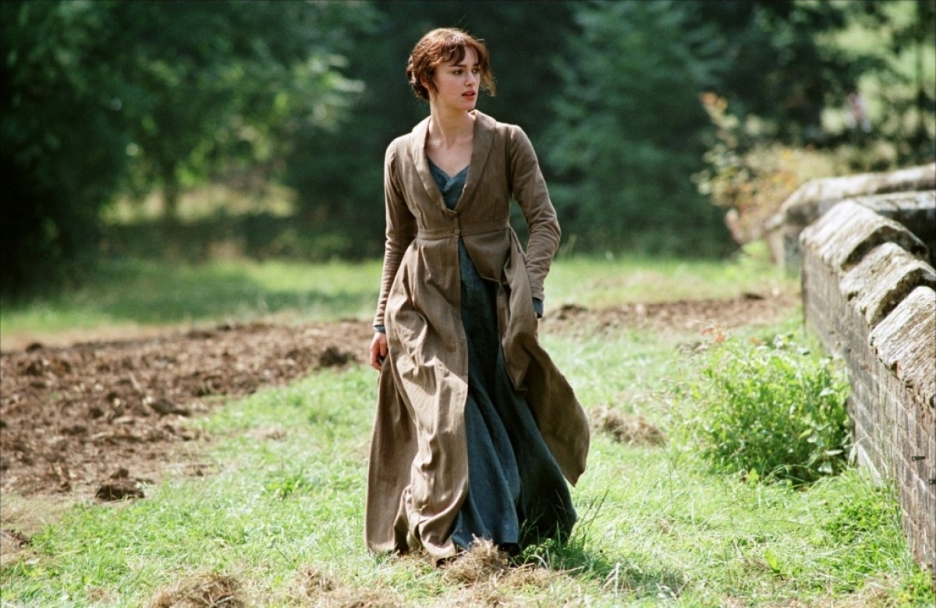
pp-elizwalkingWith blizzards about to bury the mid-west in a couple feet of snow, I’m feeling pretty lucky to be living in the northwest. This morning was absolutely beautiful – cold, crackling crisp, but clear. Still, the winter sun traces a low arc in the sky this far north, and it drops behind the trees alarmingly early in the afternoon. So, I wasted no time. I put on my hiking boots (for, like Elizabeth Bennet, I knew I would have a great deal of mud to contend with) and went for a long walk. In the incident quoted above, Elizabeth was anxious to see her sick sister Jane, who was at Netherfield. My motive was just to get some fresh air and exercise.

Jane Austen used a person’s activity level as a clue to his/her character when telling her stories. She made her favorites lively and energetic, while those out of favor often demonstrated more indolent habits (think Elizabeth versus Mr. Hurst). The fact that she expected her heroines, as well as her heroes, to be physically active, puts her ahead of her time since fine ladies of her day were not generally encouraged to much exert themselves. Elizabeth’s walk to Netherfield surprises her family and positively shocks Mr. Bingley’s sisters.

That she should have walked three miles so early in the day, in such dirty weather, and by herself, was almost incredible to Mrs. Hurst and Miss Bingley; and Elizabeth was convinced that they held her in contempt for it. …Mr. Darcy was divided between admiration of the brilliancy which exercise had given to her complexion, and doubt as to the occasion’s justifying her coming so far alone.

I didn’t have to worry about public censure when I hiked my three miles this morning. If anything, I’m in danger of being chastised by my doctor for not exercising often enough. Writing is a very sedentary occupation. But I inevitably find that getting the blood moving allows the words to flow more freely too, and a brisk turn out of doors is the best cure for writer’s block I’ve yet discovered.

Posted in Jane Austen, writing | Tagged , , , , , , , | 1 Comment

The Stories of Christmas

>

“This is quite the season indeed for friendly meetings. At Christmas everybody invites their friends about them, and people think little of even the worst weather. I was snowed up at a friend’s house once for a week. Nothing could be pleasanter.” (Emma, chapter 13)

This is an excerpt of Mr. Elton’s rapturous remarks in anticipation of the holiday party at the Westons’. We may not like Mr. Elton in general. But, on this occasion, he has the right idea and certainly a better attitude than Mr. John Knightly about venturing out in the snow to accept the generous hospitality of friends (see blog post 7/19/10 entitled Leaving One’s Own Fireside). My family experienced no weather complications this Christmas. Our “friendly meetings” went ahead as planned, with me taking my turn both as hostess and as invited guest.

When I thought about drawing a writing-related principle from these holiday gatherings, it occured to me how many instances of story telling had transpired over the last few days. My mother announced she’s begun recording an account of her life growing up. My husband shared an anecdote, something that happened to him years ago. My cousin, who has a passion for genealogy, displayed a restored photo of our mutual great great grandparents, telling what she’s learned about their life long ago in Norway. I read the Christmas story to my two-year-old granddaughter from a children’s Bible. My mother-in-law gave me two paperback novels, ones she enjoyed herself. Laughing aloud, my son viewed video of friends playing party games, as recorded on my daughter-in-law’s cell phone.

It’s all story-telling. Through one medium or another (ancient oral traditions to electronic-age technologies), it’s been a part of human existence since the beginning. Passing along practical knowledge and hard-won life experience can be viewed purely as a species survival skill. But what of memoir, humor, and all forms of fiction? Do they play an important role in our survival as well? Is that why we have an innate drive to share these forms of communication too? I don’t have the answers. I only know that the tapestries of our lives would be less richly textured without them.

Blessings to each of you this Christmas. May you celebrate this special day with your friends about you and with wonderful stories to tell.

Posted in Jane Austen, life, writing | Tagged , , , , , , , | Leave a comment

Call to Adventure

No one who had ever seen Catherine Morland in her infancy would have supposed her born to be a heroine. Her situation in life, the character of her father and mother, her own person and disposition, were all equally against her. …But when a young lady is to be a heroine, the perverseness of forty surrounding families cannot prevent her. Something must and will happen to throw a hero in her way. (Northanger Abbey, chapter 1)

Between the first and second portions of the quote above, Jane Austen tell us that Catherine is neither clever nor accomplished. Although she is allowed to look “almost pretty” on her best days, by no stretch of the imagination can she be considered beautiful. Toward the cause of heroism, the neighborhood is as disobliging as Catherine’s personal traits, refusing to offer her even “one amiable youth who could call forth her sensibility” or inspire “one real passion.” No noblemen about (not even a baronet), no squire’s son, no foundling boy, no ward of her father, no intriguing young man of unknown origin.

Austen must have had great fun writing this passage; it’s filled with her wittiest humor. But so far there’s no story, only setup. This is the “before” snapshot. Then, as the author tells us up front, “something must and will happen” to change the picture: an inciting incident, a catalyst, a call to adventure. This is a basic element of story structure, whether you’re writing romance or techno-thrillers, light-hearted comedy or literary tragedy. Catherine’s catalyst comes in the form of an invitation to accompany the Allens to Bath.

In my novel For Myself Alone, I used the same setup (an unlikely heroine). Josephine Walker tell us: When I came out into society – my debut upon the larger world – the world was generally unimpressed. Oh, my height does give my figure a certain degree of elegance and my hazel eyes are often complimented, but I believe the consensus at the time was that my looks did not much exceed the average. The young men of my acquaintance were apparently of the same opinion, since I noticed they withstood my modest beauty with remarkable ease.

Jo’s adventure also includes a trip to Bath. In her case, though, receiving an inheritance of twenty thousand pounds is actually the inciting incident, the event that changes everything, the moment her life turns upside-down. In her words: As my new-found virtue – my large personal fortune – became know, my status among my peers and betters underwent a dramatic alteration. …my faults and deficiencies quickly diminished into insignificance, and my society was soon industriously sought by some of the same young men who were so recently too squeamish to bear it.

Events propel both Josephine and Catherine into unfamiliar new worlds, and we get to go along for the rough ride ahead. In theory, their stories could be told without these defining moments of change (if Catherine had lived in Bath all her life; if Josephine had been born rich). But a catalyst, by definition, increases the rate of a chemical reaction. Isn’t that what we want in our novels?

Posted in Bath, Jane Austen, my books, writing | Tagged , , , , , , , , | Leave a comment