
I loved this book…You did something I did not think was possible. You made me like the Emma-Knightley love story. I never cared for Emma; it was my least-liked Austen book. But you fixed it! – beta reader comment

I have LOVED LOVED LOVED all of this author’s “in his own words” books. This might be the best of the lot! – Amazon customer review
An exceptionally perceptive, well-crafted, and creative augmentation of Mr. Knightley’s character and what we know of him. – Austenesque Reviews, 2024 Favorite
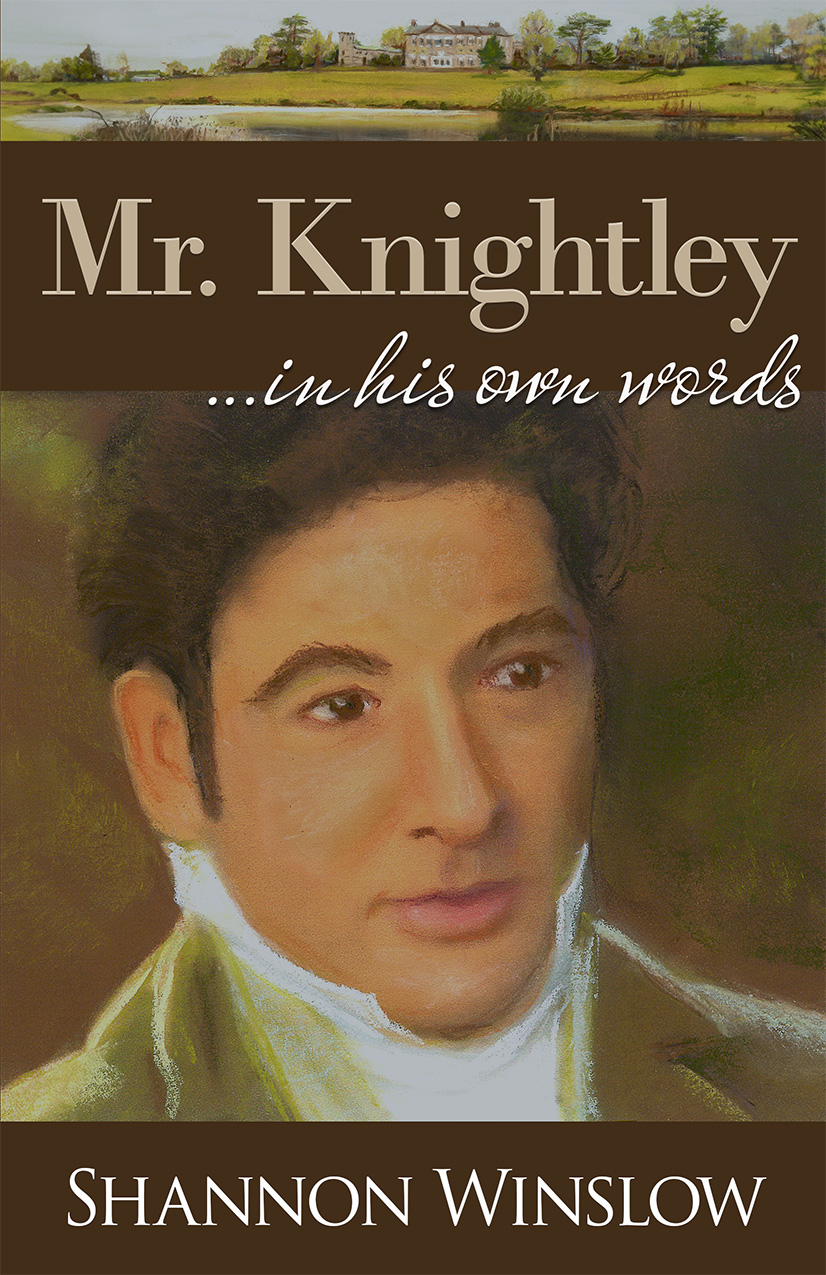
As with the others in this series, Mr. Knightley in His Own Words gives an Austen hero the chance to tell his own story, not just retelling what’s in the original novel, but much, much more. In Mr. Knightley’s case, in fact, a full 2/3 of his book is brand new prequel material, highlighting for us two key periods in his earlier life that shaped the man and his behavior thereafter.
Jane Austen tells us almost nothing about Mr. Knightley’s past. We only know that he apparently lost his parents early, since Emma says he’s always been his own master. But that’s about all. How did his parents die, and how old was George Knightley when he became master of Donwell Abbey? Now thirty-seven or eight, he surely must have had some love interest before Emma. Did it end badly? Is that why he has never married and most think he never will? Also, why is he so incredibly kind and patient with Mr. Woodhouse and his foibles? There has to be a reason beyond the fact that he’s a nice guy.
Mr. George Knightley will answer these questions for us, as well as the how/when/why of his falling in love with Emma. As with my other novels, this is a supplement to Austen’s story, not a variation from it. None of the essentials have been changed, just expanded upon. Here’s the Prologue to give you a taste. It may surprise you how I decided to begin the book – with Mr. Woodhouse! – but I promise it will all make sense presently. (You can read another excerpt in this post: Call Me “George.”)
Mr. Woodhouse is my hero and always shall be. This profession will no doubt come as a great surprise to some, especially to his more recent acquaintances, for he may not appear heroic in any way.
Mr. Woodhouse is now a somewhat elderly man with what I will call habits of gentle selfishness. He is not autocratic or demanding. On the contrary, he is mild mannered and the soul of charity itself. It is simply that he wishes to keep those he cares about near to him and cannot reconcile himself to change of any kind. These predilections seem so obvious and natural to him that he can never suppose there to be any good reason for other people to feel differently. Why should anybody wish to marry? It is so disrupting to the family circle. What reason could there be for one choosing to leave Highbury, when it is not to be supposed that there is a more comfortable place in the whole world? I have heard him say as much.
His scope of interest has contracted over the last twenty years to where his view now rarely reaches beyond his own village and the nearest concerns of himself, his two daughters, and a few intimate friends. Moreover, his valetudinarian propensities have in this same period taken a firmer grasp on him. Mr. Woodhouse is afraid, if not of his own shadow, then certainly of the threats posed by an unwholesome piece of cake and a chill draft.
But it was not always so. No, I have known him all my life, and I remember him as the man he once was, the mentor and champion of my youth. Do not mistake me; he was never by nature brave-hearted or bold. There was at least one time, however, when he faced up to a formidable foe to see that right was done. This is true heroism, not that one has no fear but that one is willing to go into battle anyway. Mr. Woodhouse did that, and he did it for me. I can never forget the priceless service he rendered those many years ago. It is for that I honor him still.
I owe him everything, perhaps even my life. So as long as I have breath, I will be his grateful servant and faithful friend. I will do my best to see no harm comes to him or to anybody he cares for. I will put his needs and wishes above my own in every case – even when it is most painful, as it is now. For the sake of that longstanding debt I can never repay, and respecting certain promises I made, I will deny myself as long as… Well, as long as it is necessary.
It would be tempting to say, “Oh, but things are different now. Circumstances have changed. One must not feel bound by promises made two decades ago.”
Yes, many things have changed in that time – it would be easier if they had not – but Mr. Woodhouse’s wishes remain the same. Therefore it is my clear duty to keep my promise to him, even now. If there is one thing a man can and always must do, it is his duty.
I hope you are intrigued and will read on! Mr. Knightley in His Own Words is available in Kindle, paperback, and audio formats here. Also available in paperback and Nook through Barnes and Noble.
 Join me as I weave together my passion for writing and my love of all things Jane Austen. Please also look for me on Facebook.





 Shannon Winslow's "Jane Austen Says..."