

I have a couple of movie reviews for you today! I’m calling this post “Second Chance Reviews” because these are Jane Austen adaptations I didn’t like at all when I first saw them. In fact, I watched them each once, gave them both a thumbs-down, and never intended to see them again. But someone recently suggested I give them another look with an open mind, that I might find something I could appreciate about them.

That’s what happened with the 2020 Emma movie, I remembered (see my review here). At first I didn’t know what to think about that unorthodox interpretation of the classic novel. But upon watching it a second and a third time, it definitely grew on me. I could appreciate it for what it was instead of being so focused on what it was not: a faithful copy of Jane Austen’s novel.
But would the same method work for these two?
Let’s start with PERSUASION 2007:
First Impression: I first watched this one years ago, but what I remember holding against it were: 1) multiple deviations from the book, 2) Anne’s frenetic running all over Bath at the end, 3) the improbability of Wentworth being able to buy Kellynch for Anne (it was meant to convey to the heir), 4) and I felt the leads (Rupert Penry-Jones and Sally Hawkins) were really mismatched. Right, but I was going to keep an open mind, wasn’t I?
After a Second Look: I have to say that the above items are still issues for me, although some are a little softened. But I did find things to like about the movie as well!
I’m still surprised and mystified at the ways the screenwriter of this production chose to change the storyline. These are the two most questionable examples, imo. First, relocating the Anne/Harville conversation (about whether men or women love longest) to an earlier position, making it an Anne/Benwick conversation. What’s important isn’t who Anne’s talking to; what’s important is that Wentworth is supposed to overhear it, her words piercing his soul, and prompting him to write the famous letter that reunites the couple at the end. That doesn’t happen in this adaptation! He doesn’t overhear any of it, so why include the conversation at all?

Secondly, The bit about Frederick being ready to settle down has been oddly transplanted as well. Instead of a private conversation with his sister (as in the book), now we have Captain Wentworth himself announcing these things to the whole company over dinner – “I am resolved to settle down…Anybody between 15 and 30 may have me for the asking… What I desire in a wife is firmness of character.” I doubt this is the kind of thing that would have been discussed in open company, especially with 3 unmarried females present! Is one of them supposed to pop up and say, “I’ll take you,”?
As for all the ridiculous running around Bath (well-bred ladies would never run in public), the cringy open-mouth waiting-to-be-kissed scene, and various other oddities… Well, probably enough said. And I still can’t really see SH and RPJ as a couple. I know it’s shallow of me, but imo they just don’t “look” right together. I guess what it comes down to is that the girl should be the pretty one. There, I’ve said it. (My apologies to Sally Hawkins, who is a fine actress.) The issue of Wentworth “buying” Kellynch for Anne was somewhat resolved by the explanation (volunteered in a FB discussion) that he could have procured it for her with a lease instead.
What I Liked: I can’t deny that I enjoyed Rupert Penry-Jones as Wentworth. He played the part sensitively and is obviously very easy on the eyes too. I also enjoyed the scene in Bath, when Wentworth speaks to Anne about everything being set for a union between herself and Mr. Elliot, but she says he is “utterly misinformed.” It was very satisfying that she got the chance to tell him the truth. But probably the biggest plus to this adaptation is that we hear so much of Anne’s internal monologue, a lot of it at least close to things Jane Austen wrote in her narrative, such as a version of, “there could have been no two hearts so open, no tastes so similar, no feelings so in unison, no countenances so beloved...” It helps to reveal what she’s feeling and why, and it’s lovely to hear more genuine Jane Austen.

Shocker: I think of Anne’s friend Mrs. Smith as a total invalid, who can’t move without assistance (as she is in the book and in the other adaptation), and suddenly, towards the end, she comes running up to Anne on the street! I was taken completely by surprise. I felt like shouting, “It’s a miracle!”
Conclusion: So, did I find things I liked that I hadn’t noticed before or didn’t remember? Was it worth a second look? Yes, definitely. And I can better understand those who are devoted to this adaptation. Was I completely won over myself? No. I still prefer the Amanda Root / Ciaran Hinds version, although it’s not perfect either. (But that’s a review for another day!) I give this one 3 stars.
Now, on to MANSFIELD PARK 1999:
First Impression: Honestly, I don’t remember anything very specific about why I didn’t like this one when I first saw it ages ago. It was probably the ways it departs from the novel, the fact that Fanny doesn’t seem completely true to character, and a collection of other little things that bugged me this time too. I only know I was disappointed at still not finding a MP adaptation that I wanted to add to my movie collection.
After a Second Look, though, I really did warm up to this one. Perhaps it was my more open-minded approach, or the fact that I wasn’t expecting a perfectly faithful interpretation of the novel this time, but some things that would have bothered me before, didn’t so much this time.

What I Liked: Although not portrayed exactly as in the book, I liked this Fanny (Frances O’Connor) and her relationship with Edmund (Jonny Lee Miller). It just worked, and I believed their friends-to-lovers progression. You may be surprised to learn that I also actually enjoyed the innovation of adding some of Austen’s juvenilia to the film in the form of Fanny’s supposed writings (although I could have done without her speaking directly to the camera). There was something appealing in the overall style of the film too, a touch of subtle humor, set in part by the musical score.
What Could have Been Better: We’re given very little idea of Henry Crawford’s true character until the end. We don’t see much of his flirtation with the Bertram sisters. We don’t hear him tell Mary that he intends to make a small hole in Fanny’s heart. So the viewer may not understand why Fanny distrusts him. And I don’t agree with the choice to have Fanny accept him in Portsmouth and then reject him again the next day. Was that an allusion to Jane Austen’s own history with Harris Bigg Wither? In any case, I would have preferred Fanny stay true to her convictions (as she does in the book), never giving in to Mr. Crawford or giving him false hope.
The Unnecessary “Ick” Factors: Sir Thomas’s lechery. Mary Crawford’s getting too touchy-feely with Fanny. Henry Crawford’s tryst with Maria taking place at Mansfield Park, where it was discovered and seen by Fanny, Edmund, et. al. The graphic drawings from Antigua.
Handling the Slavery Issue: Although there is a passing mention of the slave trade in the novel, much more is made of it in this movie, especially as regards Sir Thomas’s plantations in Antigua. I applaud Edmund’s rueful acknowledgement (after Fanny has said that surely the abolition movement is a good thing), “We all live off the profits, Fanny, including you.” That very succinctly gets the point across. No need for Tom’s graphic drawings, etc.
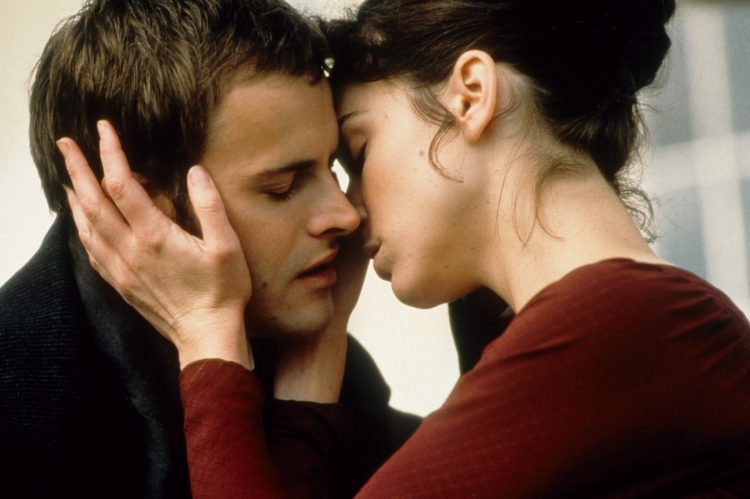
Favorite Moments: Discovering that the same actress (Lindsay Duncan) plays 2 roles – the sisters Mrs. Bertram and Mrs. Price. Fanny’s impertinent comeback line to her Aunt Norris, “And how long are you staying?” And the freeze-frame tableau at the end of the film with Fanny’s voiceover line, “It could have turned out differently, I suppose, but it didn’t.”
Conclusion: My second look paid off. To paraphrase Lizzy Bennet, “I think this movie improves on acquaintance. In essentials, I believe, it is very much what it ever was, but from knowing it better, its disposition was better understood by me.” I’m giving it 4 stars and adding it to my movie collection.
So, there you have it. The results are one thumb mostly up and one improved but still trending down. That’s just my opinion, though. Everybody’s tastes are different, so now I want to hear from you. Have you seen these two movies? How would you rate them? Best or worst moments, cast members, etc.? Have you ever learned to like a movie that you didn’t at first? It’s your turn to talk!
Interested in MORE MOVIE REVIEWS? Visit my Movie Reviews page for a complete list with links!

 Join me as I weave together my passion for writing and my love of all things Jane Austen. Please also look for me on Facebook.




 Shannon Winslow's "Jane Austen Says..."
Shannon, I attempted to leave a comment but was told I needed to sign in with a password. I don’t remember having to do this before with one of your blogs. Sheila Majczan
Well, that’s weird! I haven’t changed any settings. But somehow you succeeded! Thanks for reading. 😀
I share most of your opinions re these versions. I do give Mansfield Park some leeway on foregrounding the slavery issue, as the novel contains additional coded references that modern readers miss. Still, the way it’s dramatized does feel over-the-top and extra ick, rather than the complex subtlety of Jane Austen generally.
Mansfield Park overall is tough for modern readers to appreciate or like, since Fanny Price is so timid, and although many will get the basics that “adultery bad, faithfulness good, don’t marry someone you can’t love/respect,” still Fanny & Edmund can both seem too prudish at times. And she’s determined to respect people who, let’s be honest, have neglected and/or abused her as a child. But then, the ways she does demonstrate backbone and agency late in the story often get glossed over – defying Sir Thomas in her refusal of Mr. Crawford. The change & growth disappear if she has such a different personality as in the 1999 and other interpretations. I haven’t seen any version that lets Fanny be Fanny.
Thank you for pointing out that Jane Austen handled difficult issues like slavery with “complex subtlety,” rather than throwing them in your face.
Yes, Mansfield Park is difficult to adapt for a modern audience because Fanny is not in the style of a modern heroine. Her strength is subtle and often overlooked or under appreciated. As for showing respect to people who don’t deserve it… Here again, “respect your elders” and “honor your father and your mother” are themes not as strongly upheld today as then. But Fanny subscribed to them, which made it incredibly difficult for her to defy Sir Thomas’s wishes for her to marry Crawford.
Thank you, Ruth, for visiting and for insightful comments!